
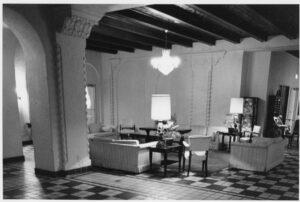
The Shorecrest was built in 1924, and an addition was put on in 1929. The first floor was office and restaurant space, floors two through eight had apartments with one, two or three bedrooms. There were 112 units. The ninth floor was a ballroom. In the basement, the hotel had an in-house tailor, beauty parlor and bakery. The materials were brick, terracotta, tile and copper, in what would later be described as a “Moorish” design or a mix of Moroccan and Art Deco.
The firm that designed the hotel was Martin Tullgren and Sons, and it was specifically Herbert Tullgren on this project. We know this because Martin (his father) died in 1922. Herbert has been described as a regionally important architect, who designed many apartment buildings, schools and more in the Milwaukee area, and up towards Sheboygan. With his father, he designed Milwaukee’s Astor Hotel (which is done in Renaissance Neo-Classicism style).
The restaurant space was originally a cafeteria, but became a cocktail lounge in the 1930s, a Greek resturant in the 1960s, and later Snug’s. George Zagel Brothers, architects, designed a parking lot in 1957.
Joseph Balistrieri purchased the Shorecrest Hotel on December 14, 1971 for $1,100,000. The owner, who had inherited the hotel from his father Arthur W. Bruemmer, wanted $2,850,000 for the building, but only received two offers and Balistrieri’s was the higher one. The record is a bit hard to discern (it is heavily redacted), but allegedly Frank Balistrieri was able to get associates to loan money for the investment, and it was brought into Joseph’s bank account through cashiers checks made out to cash. A prominent member of the Teamsters loaned money from his pension, despite being scheduled to undergo open heart surgery in December —money that his family would be
unable to get if the operation went badly. Balistrieri had a $656,000 mortgage on the hotel through First Federal Savings and Loan. A second mortgage for $296,000 came from Midland National Bank. The loans were backed by Joseph Balistrieri’s ownership of five apartments at 2200-2216 East Kenilworth Place, which he had purchased the prior year for $110,000 with the help of alderman Allen Calhoun, who acted as appraiser.
The press later asked Calhoun what his role was in the Shorecrest sale. He said, “I am a real estate broker. I furnished the buyer to Mr. Bruemmer. I knew Joey was looking for a piece of real estate, and I knew the Shorecrest was available. Once the offer was accepted, I was out of the picture. It was a matter for (realtor Henry) Grueber from then on.” Calhoun denied taking any fee on the sale.
Around December 16, 1971, a source spoke with state investigators about the Shorecrest Hotel. They claimed that the owner, Arthur Bruemmer, had been in a room above the Kings IV the previous spring and got into some sort of trouble with a woman, possibly a prostitute, and there was a fight. Soon, Bruemmer was driving in Mequon and was forced off the road by someone saying the Balistrieri family wanted his hotel. He had previously asked $2,850,000 but sold it to Joseph Balistrieri for $1,100,000. Balistrieri was able to put $100,000 as a down payment and had the rest financed by First Federal, signed off on by Robert Brown. Allegedly, a little muscle was put on Brown because First Federal only wanted to loan $500,000. AB was overheard telling his attorney, a man named Lichtsinn, “this means more to me than my life.” The source claimed Frank Balistrieri engineered the whole thing while in town for a grand jury appearance.
On January 27, 1972, the former owner of the Shorecrest appeared at the Milwaukee office of the FBI with his attorney. Bruemmer had been hounded by news reporters since the sale of the hotel, and would ask him if it was true if he had been beaten and forced to sell. The man denied any coercion and said he wanted to sell —he did not care to whom —and Balistrieri offered the highest bid. The FBI believed him and closed their books on a potential extortion investigation.
An excerpt from John Balistrieri’s autobiography:
A building downtown on North Water Street was purchased in the late 1960s while I was still in school. Originally, it was the family grocery store of the Schlitz brewing family. Rehab began, but First Federal Savings and Loan (who owned the adjacent property and was a major force in the city) wanted to expand their offices. They wanted the building. Joe didn’t want to sell, and my father planned to put in three floors of restaurants and bars in the building. Joe was thinking of moving the law office there. Because it was in the financial district, it was in an excellent location for a law office and rental space for other legal or business offices. But, as usual, my father insisted that things be done his way, so remodeling the building into three floors of restaurants began.
First Federal came to us and said either we sell the property to them or they would have the building condemned and take it by eminent domain. We responded telling the First Federal lawyers, “You can’t have it condemned. You’re not the government. You don’t have the authority to use the eminent domain laws to acquire it.” But, in fact, they did by declaring the surrounding neighborhood a depressed area. That resulted in the building being threatened with condemnation as part of a larger redevelopment project. So we sold it. We got a very good price as a result of the sale along with a commitment for a loan to purchase another property.
We tried to buy the Astor Hotel, but they wouldn’t sell it. At the last minute, Henry Piano, an old and trusted family friend and excellent lawyer, told us that the Shorecrest was for sale. The Shorecrest Hotel was a residential property which was built in the 1920s by the Uihlein family who owned and operated the Schlitz Brewing Company in those days. In 1971 it was owned by two brothers named Bremer. The brothers were fighting with each other, so a deal was possible. They were happy to sell to us. The animosity between the brothers was so deep that they were destroying the building, knocking out walls, and tearing up the ninth floor. The building was not in good condition. The Bremer family was saved by competent management. We kept them on, including a housekeeper by the name of Ann Lynch. She didn’t know what to make of us at first, but she ended up working for us until she died. Mrs. Lynch became not just an employee, but part of the family. She was competent, honest and loyal. Returning from a business trip I entered my apartment to find it completely empty. I thought I had been robbed. While away Mrs. Lynch had moved me in to a larger apartment I had decided to take. My furniture was neatly in place and my clothes neatly put away. With Mrs. Lynch in charge of the housekeeping and my mother in charge of the office, the business ran well. We began to upgrade the property and turn it into a profitable enterprise. They gave the hotel the woman’s touch it needed to bring out the best in the property.
My brother and I concentrated on making the Shorecrest our flagship property, business headquarters and our home. As such, it was meticulously maintained and well run. Our residential clientele was drawn from many of the city’s mainline and well respected families. This fact, combined with the growing popularity of the restaurant and nightclub operation which we created, made the Shorecrest Hotel a destination location. It developed an excellent reputation. However, the cost of maintaining the hotel at such a high standard became very expensive, especially in a city like Milwaukee where fixed overhead expenses far outpace the operator’s ability to obtain the necessary cash flow. However, with Mrs. Lynch and my mother overseeing the operation, things were working out fine.
We amicably terminated the lease of the tenant who had occupied the restaurant space in the hotel when we acquired it in 1971. It was clear to Joe and me that the type of the restaurant operation in the hotel at the time we acquired it was contrary to our vision for the property. After the tenant vacated the location, we completely remodeled the space and worked to update the room. We changed the design to bring out the original architectural strengths of the space which had been hidden for many years by the various remodeling efforts of the numerous tenants who had occupied the space since 1928. The architectural style of the property, which we discovered after researching the project, was known as Mediterranean Art Deco. We wanted to restore the original look and feel of the 1920s era.
Remodeling became a difficult, complicated, and expensive proposition. When we had completed our modifications not only had we completely changed the look of the restaurant space and lobby area, but had also changed the nature of the operation. The result was a high-end restaurant with a big city look and feel. The look of the restaurant was enhanced with authentic artwork. Oil paintings, not prints, and high quality bronze pieces, including a central theme bronze cast in Paris in the 19th century, were used to create the desired ambiance. The piece was a replica of a statue which stands in a prominent location in the Louvre Museum in Paris. The effort and expense were rewarded with success. We had a hit location. Business was good. Joe and I felt we were on our way at last.
Kosta Demopoulos was in the restaurant space when we bought the building. He operated two restaurants each called Kosta’s White Manor. One was in the Shorecrest and one was on Juneau Avenue near a park. As entertainment in his restaurant he employed Greek ethnic dancers. Unfortunately, he would become romantically involved with them, which lead to heated arguments spilling out of the restaurant and in to the lobby. As you can imagine, it was not the kind of image we were trying to create. Greeks, like Italians, can become emotional in matters of the heart.
I said to Joe, “This guy has to go. He’s falling in love with his dancers, and they’re fighting in the lobby. Things are getting out of control. It’s not the image we want. We have too much invested for this situation to continue. Let’s talk to Kosta.”
I was about to make Kosta an offer to leave when it just so happened that he beat me to it. He came to the law office saying, “I can’t operate two places. I’m losing money.” I told him if he gave us four month’s rent, we would let him out of his lease. He did and he closed down the restaurant in the hotel. We liked Kosta. He was a gentleman and an interesting character. We parted as friends.