Harry A. Gromacki was born December 11, 1915 in Wisconsin (probably Milwaukee) to a pair of Polish immigrant parents. He lived at 1314 Fratney Street (whic his now 3140 Fratney in 2025). This is in the Riverwest neighborhood which was heavily Polish from the 1880s through 1960.
As a young man, Harry distinguished himself as a capable pitcher. It wasn’t something he could make a career out of, but he was regularly written up in the newspaper.
In 1938, he married Eugenia “Jean” Buraczewski, who likewise had been raised by Polish immigrants. After their wedding, the couple first lived with Jean’s parents at 3442 North Holton, which was also in Riverwest. The families still lived together in 1950, though by this time Harry had six children – the Gromackis had outnumbered the Buraczewski! In the 1950 census he says he operated bowling games and other amusement devices, while simultaneously being employed as a bridgetender.
Harry’s brother John was a Milwaukee alderman from 1948-1956. (This doesn’t seem to matter.)
Harry and family moved to 222 East Burleigh in 1951. The house is today considered historic as it was built some time between 1857 and 1864 (I suspect the latter) and sat on three acres of land, meaning it is easily the oldest house in the area.
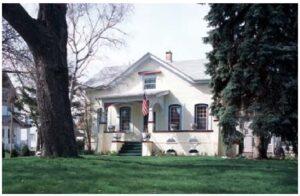
Harry remodeled a bathroom in the house in late 1951 and built a new 31.5 by 21 foot garage for $1200 on the site of the Neidner garage on Lot 25 in 1952. Sanborn maps show that the structure was also used for the repair of jukeboxes. More plumbing fixtures were replaced in 1953. In 1963 the Gromacki’s constructed a 30.8 by 26 foot two-story addition to the north west corner of the house at a cost of $5,000. The first floor was used as garage space while the second floor consisted of a den and dining room. This project was completed in June of 1957. The addition was designed in a contemporary fashion and no attempt was made to match the scale, fenestration or materials of the original house. The Gromacki’s subsequently enlarged the kitchen in 1957 with a one-story 24.7 by 6.6 foot addition which shows up as a appendage at the east side rear of the building.
The house sustained fire damage to the floor joists flooring and framing around the chimney in December 1959 but was repaired. A faulty garbage burner in the basement was enough to scare Jean Gromacki and her children from the home and cause $2,500 worth of damage. A fireman who responded, 30-year old Robert Beauchamp, used a sledgehammer to smash glass blocks from the basement window and ended up getting glass splinters in his eye.
June 1962, the IRS said Harry Gromacki had under-reported income of $56,461 between 1954 and 1957. The unpaid tax, plus fraud penalties, totaled $27,643. Gromacki protested this, saying his taxes were prepared by accountant William Wanta, and if there were any errors, it was inadvertent and not an intentional attempt to defraud.
In 1963 the Gromackis converted their house into a duplex and were going to add a third living unit in 1964 but changed their minds. They then moved to 6975 North Milwaukee River Parkway in Glendale.
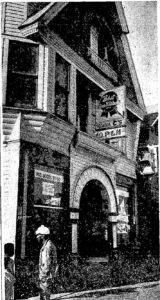
September 17, 1974, Gromacki was servicing machines at Mister C’s Tavern (501 West North Avenue) when he was the victim of bad timing. A 15-year old boy and a 14-year old boy were looking to rob the tavern, but found it empty. Then they saw Gromacki, who had a metal case he used for his tools. They mistook it for a cashbox and the 14-year old shot Gromacki dead at the tavern doorway. The shooter was apprehended right away and the older boy was found after disposing of the box in an alley a couple blocks away.
On September 26 – a mere nine days later, the two boys pleaded guilty before Children’s Court Judge Victor Manian. Assistant district attorney Robert Donohoo expressed disappointment that Wisconsin law said you had to be at least 16 to be tried in adult court. The 14-year old, the actual shooter, could only be sentenced to four years. The older boy was given two years. For a murder and robbery, they would both be free by age 18 and their names were kept private.
(The podcast version of this story includes John Balistrieri’s memories of Harry Gromacki and managing the business after Gromacki’s death. Because the text may appear in a forthcoming book, it is not presented here.)