Florence Teacher was born January 3, 1921 in Chicago to Isadore Teacher and Betty Glasser. Her father was Scottish and mother Irish, and possibly Jewish. Florence would go by Tamara most of her life, which may have been her middle name.
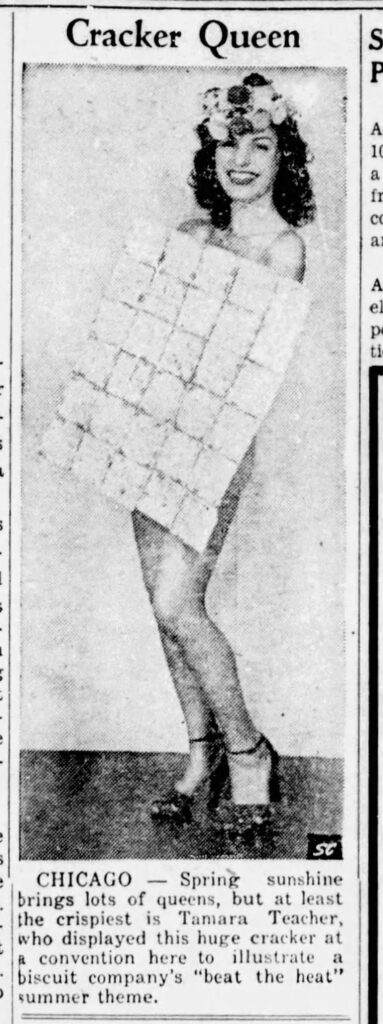
In June 1947, photos appeared in Illinois newspapers of Tamara Teacher in a swimsuit and wearing a giant cracker to advertise for a biscuit company at a convention in Chicago. No further context is given to the photo, and it’s not even clear if this is the same person, though I suspect it is.
The family moved to San Diego, and Tamara married Dr. Phillip Rand, a gynecologist. He had been born in Milwaukee and his last name was originally Rubin. The reason for the change is not known. Perhaps to sound less Jewish? I don’t know why that would matter, but I have no other guesses.
Tamara Rand involved herself in many successful business deals in California and Mexico.
In 1975, Rand was suing Allen Glick, alleging she was entitled to a five percent stake in Argent (which owned the Stardust and Fremont casinos) for earlier lending him and his Saratoga Development Corporation $500,000. Rand then escalated her civil actions against Glick by filing criminal fraud charges against him. She had won an important and dangerous victory in court: she and her attorneys were given access to corporate documents pertaining to the Teamsters pension fund loan.
On November 9, 1975, 55-year old Tamara Rand was shot five times in the head and killed in the kitchen of her house in the Mission Hills section of San Diego. The murder occurred between 3:00 and 5:30pm, and no one heard the shots. The killer used a .22-caliber with a silencer; there was no sign of forced entry, and nothing was missing. The body was found by Rand’s husband when he got home from work.
Allen Glick found out that Tamara Rand had been murdered when he got off the Argent private jet in Las Vegas and was greeted by reporters and TV cameramen asking his reaction to the murder,” Pileggi’s account continues.
After expressing shock, he jumped into an Argent limousine and fled the scene. The next day the Argent public relations department issued a statement saying that while Glick had known Rand and had fond memories of her as a friend, he had no other comment. Weeks later, police had still failed to find him, as he was out of town whenever they stopped by.
A week after the murder, the San Diego Union reprinted a letter Rand had written seven months before she was killed, detailing her relationship with Glick. It accused Glick of living like royalty, of flying friends to football games in the company plane, of surrounding himself with a ‘parade of toys.’
November 17, 1975, Rand’s safety deposit box at San Diego Trust and Savings Bank was opened. Co-tenant of the box was Henry Glasser of San Francisco. Investigators told the press that Rand had been watched by authorities for some tiem because of her worldwide business dealings and they suspected the box contained a lot of money. It held, in fact, $453,000.
A month after the killing, police Captain Kenneth O’Brien said, “We haven’t established a damn thing. We aren’t going to solve it in an hour like Colombo.” On December 16, acting Chief William Kolender said he felt Rand “became a threat” to organized crime. “Somebody wanted her out of the way,” he said. “Our investigators have reached the point where they are satisfied she was murdered by a professional.” He pointed out that the murder weapon was a 10-round .22 automatic with an 8-inch silencer. This was the same type of weapon that killed Chicago Outfit boss Sam Giancana a few months earlier. Analysis of bullets from both killings found the weapons used had been altered in the same way.
Homicide detective Ed Stevens added that although Rand had been a threat to organized crime, there was no evidence that she had knowingly involved herself in organized crime or associated with the Mafia. Stevens said Rand had received threats since May, but declined to say who the threats came from. Stevens said that Glick still refused to answer questions unless he could do so in writing (which the police denied), so the police had interviewed associates of Glick: newspaper publisher Hank Greenspun, casino manager Frank Rosenthal, Buzz Hudson and Larry Goff.
Glick, still not talking to police, called a press conference at the Stardust executive offices. He said he was “the subject of one of the most malicious characterizations based upon utter falsehoods, devious unnuendos and criminal-sounding inferences” for no reason. He acknowledged a business dispute with Rand, but said that was no reason to connect him to a vicious murder. He then made some statements that would later be questionable. He said, “To associate me or any department or employee of my company with so-called ‘organized crime’ is false… Allen R. Glick has never, nor will ever be associated with anything other than what is lawful.”
At the end of 1975, Glick removed himself from Saratoga Development, leaving it with business partner Dennis Wittman. The company was going through bankruptcy, with Wittman hoping to reorganize. Tamara Rand’s earlier $500,000 lawsuit against Glick was now filed with the bankruptcy court by her husband Dr. Phillip Rand and estate attorney Henry Glasser. Glick, as near as I can tell, got himself off the hook for this. (The bankruptcy was due in large part because Saratoga had taken out a $3.75 million loan from Home Federal that they could not afford – it was granted at the time because of support from the Teamsters. Many irregularities were uncovered – maybe I’ll add those in before posting online.)
By 1979, if not earlier, Frank Rosenthal “flipped” and became a major FBI informant under the code name Achilles. He gave his view on several unsolved murders. Regarding Tamara Rand, he claimed that the “contract” was put out by Allen Glick and carried out by Harry Aleman and someone named “Corky” he did not further identify. Aleman was certainly capable of the job – he was a known hitman – but one has to wonder if Rosenthal actually had access to such information. Also, there’s no way Glick could have ordered a murder – at best, he identified weak spots and the mob made the decision to kill Rand. (If Glick is to be believed, he was always the victim, but I’ve never believed he was as naive and innocent as he made himself out to be.)
Glick always denied having anything to do with the Rand killing, and the murder remains unsolved. Writes author Nick Pileggi: “According to the FBI, Tamara Rand was murdered to protect the skim; her murder was ordered by Frank Balistrieri.”
In 1989, Dan Moldea published “Interference,” a book on Mafia influence in pro football. He tocuhes on the Rand case with a slightly different angle. Moldea says the killing was likely carried out by two men: Harry Aleman and William “Butch” Petrocelli. He claims Petrocelli was booked at a San Diego hotel near the Rand house around the time of the murder. (He would later be killed.)
The NFL connection was that Glick owned the Eastmont Mall with Al Davis, owner of the Oakland Raiders. Following the Rand murder, Davis took heat for his association with the now-toxic Glick. Allegedly, in addition to being looked at by the NFL, Davis also got flagged by the IRS. Davis said he was friends with Glick, but did not see that as a problem. While sports gambling was generally illegal, it was legal in Vegas – Davis pointed out that other team owners had owned greyhound tracks or race horses and nobody found that to be a problem. Why should casinos be different?
As of this writing (December 2025), I believe Rand has two living daughters. They are not being identified to protect their prvacy.