(Much of the early years is covered in detail in my book, “Milwaukee Mafia: Mobsters in the Heartland.” A very broad summary is here for context.)
Frank LaGalbo was influential among the Mafia in the 1920s and 1930s, referred to as a “little boss.” He was deeply involved in prostitution, was a prime suspect in a murder, and successfully avoided deportation in 1939. In the 1940s, he was close to rising star Frank Balistrieri and became godfather to one of Balistrieri’s daughters (I believe Catherine).
Around 1955, LaGalbo was ordered killed. The exact reason is unknown, but it was likely related to the uprising with Jack Enea (another close friend) and John DiTrapani. LaGalbo appealed to friends in Chicago, and it was decided that he would be transferred to the Chicago Heights crew, despite not actually moving from Milwaukee. In 1961, building up to the time Balistrieri took over, there was much speculation that LaGalbo would be the next boss – something favored by many of the older crew.
In 1965, when Balistrieri was going through his tax troubles, old timers again supported the idea of LaGalbo taking over, as opposed to the frontrunner Joseph Caminiti. LaGalbo was seen as a “neutral” choice – he was a friend of Balistrieri but did not suck up to him like many others.
Chico’s Restaurant (owned by Frank LaGalbo) suffered an extensive fire that completely gutted the interior in October 1966. He did not get many mentions in law enforcement files after this – the temporary lack of restaurant limited his connections, and he primarily showed up at weddings and funerals.
Special agents went to Chico’s on January 26, 1973, and spoke with Angeline LaGalbo, who they described as “uncooperative”.
Frank LaGalbo called the Grande Cheese Company in Fond du Lac in January, March and April 1973. Some time in early 1973, he made calls to George F. Kouba (a restaurant supply salesman) in West Bend. In January 1973, he made calls to both Anthony Balistrieri, 924 Melrose Avenue and Balistrieri’s Red Coach nightclub in Chula Vista, California. (Anthony was the son of “Big Frank” Balistrieri, Frank P. Balistrieri’s uncle.) LaGalbo called the office of Alfred J. Pilotto, head of the Laborers International Union (and successor to LaGalbo’s friend Frank LaPorte), in February 1973.
Frank LaGalbo threw a benefit party at Fish’s Tavern (run by Tommy “Fish” Piscitello) on June 10, 1973, for his brother Sal who was sick. Guests included Frank Balistrieri, Vince Maniaci, Sam Cefalu, Paul Bogosian and Steve DiSalvo.
August 3, 1973: State agent Herb Krusche met with informant OCI-18. He said Sally was negotiating the purchase of Chico’s from Frank LaGalbo, including the equipment, for $75,000. Informant did not know where Sally got the money, but Frank Balistrieri was not happy that she was “getting just a little bit too big for her britches.”
An informant advised the FBI in April 1974 that Frank and Angeline LaGalbo frequently visited a relative of Angeline’s at Southern Colony in Union Grove. Southern Colony was an institution for mentally disabled people.
On May 29, 1974, Robert Puccio (of P&P Distributing, a coin machine company) purchased Chico’s from Frank LaGalbo for $110,000. The loan was financed by the West Allis State Bank.
On June 27, 1974, Puccio entered into an agreement with Frank Trovato for the property – a $100,000 contract at 9.5% interest. Trovato was to pay Puccio $1,044 per month. The property would soon be changed from Chico’s to Trovato’s, managed by Frank Trovato.
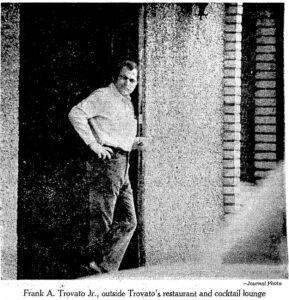
Frank Trovato, a former boxer, received the license in July 1974. He had formerly worked as a bartender for Sally’s II in Milwaukee and then the Riverside Restaurant in Illinois, operated by the Buccieri brothers. Both of these businesses burned down, and Trovato returned to Milwaukee to manage Dimicelli’s on West Wells. When Trovato applied for the Chico’s license, he said on the form that he had no criminal convictions. The police disagreed, pointing to such incidents as him punching out Frank Fazio when Fazio badmouthed Sally. Trovato’s record had numerous arrests for battery, disorderly conduct and gambling. Trovato swore the police arrest record was incorrect, with his statement notarized by Frank Calarco, an attorney who worked out of the Balistrieri law office.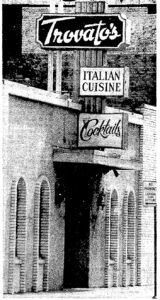
George Kouba was interviewed by special agents on August 5, 1974, concerning his relationship with Frank LaGalbo. Kouba said he was previously employed as a salesman for Sexton Foods and was currently a salesman for the B. A. Railton Company, both suppliers of restaurant groceries. He said he stopped by Chico’s once and spoke to Angeline LaGalbo and had spoken with Frank over the phone concerning about $200 in groceries. Kouba stated he had no further contact with LaGalbo and, in fact, had never even met him in person.
October 15, 1974: An informant said that since Frank LaGalbo sold his restaurant, he did not appear to be active with the criminal element and was becoming senile.
Chicago Heights capo Alfred Pilotto called Frank LaGalbo at his home twice on August 21, 1975. The nature of these calls is unknown.
On May 24, 1976, Frank LaGalbo, who had previously been tied to various murders in Milwaukee, died of a gunshot wound to the right side of his head. He was 68. The weapon was a 6.35mm Astra automatic. Although it appeared to police as though he was getting into his car, the medical examiner ruled it a suicide. Two suicide notes were found in his home. Police noted that LaGalbo had been in fear of his life for a long time, and his cottage near Peshtigo was a well-guarded fortress. LaGalbo’s brother-in-law, tavern owner Joseph Regano, was with Frank the morning he died and said Frank was depressed, especially since suffering a stroke in January that left him paralyzed on his left side. They were about to drive to St. Mary’s hospital for physical therapy when LaGalbo pulled out the gun. (Regano was a brother-in-law because he was Frank’s wife’s half-brother.)
Any mob member who dies of a gunshot wound is worth looking into. In this case, maybe even more so – he had once been almost deported, and later was kicked out of the Family. It wouldn’t be a shock if he was made a target for some reason. I requested the death investigation file, and to the credit of the police, they had the same concerns. However, I am satisfied that they did a thorough job on this one and the suicide is exactly as it appears, even if LaGalbo picked a strange moment to carry it out.
Frank had no children, but his nephews briefly opened a new Chico’s after his death. It did not last long. There’s no indication his nephews or brother-in-law had Mafia ties.