Edward Minkowski Senior was a tavern keeper and part of a “liquor ring” in 1922 (Prohibition).
Edward Verne Minkowski Jr. was born in Kenosha on September 11, 1925. He attended Kenosha schools and later graduated from the University of Notre Dame.
The elder Minkowski was kidnapped in 1932 by Illinois gangsters who demanded a $25,000 ransom. He was later released unharmed. A suspect in the kidnapping was shot shortly after.
Minkowski entered the US Army on March 23, 1944 and served with Company K, Infantry, 87th Division in the European theater, in Rhineland Comp and Ardennes. He was wounded in Belgium and taken as a POW by the Germans. Minkowski was awarded a Purple Heart and was honorably discharged on February 15, 1946.
On April 26, 1952, Edward married Elizabeth A. “Betty” Drago, a local girl, in Kenosha.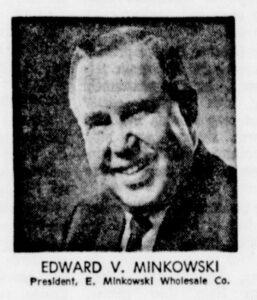
October 26, 1963: Edward Minkowski Sr passed. He left behind an estate of $877,000.
During a 1963 investigation into Kenosha gambling, it was found that Minkowski owned a building leased to Carl “Cookie” Scola, a known bookie. Minkowski was not implicated in any gambling.
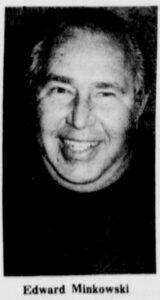
Minkowski, 49, president of Kenosha Liquor Company, was shot once in the back with a .22 on July 8, 1975 while sitting in a parked 1974 Buick Electra at 6640 15th Avenue, on the south side of Kenosha. That bullet punctured his aorta and caused him to hemorrhage. He was found early that same morning.
According to Captain William Schorn, “We received an anonymous phone call at 2:53am that there was a gunshot in that neighborhood. A squad was sent to investigate and found the subject slumped over the wheel of his car.” It was not immediately known why Minkowski was in that neighborhood – he had recently sold him home and was planning to move to Florida within a month.
Minkowski was survived by his wife, Betty Drago Minkowski, mother Lillian Mawacke Minkowski, and daughters Janet, JoAnn and Jeanine (all still living at home). There was also a sister, Ethel Minkowski Schaefer.
The next day, Captain Schorn said the investigation was continuing. Was questioning people in the neighborhood, they established where Minkowski was up to the time of his death. Schorn also said it was officially a homicide investigation – no weapon was found at the scene, ruling out any possibility of suicide. The motive was unknown – Minkowski’s wallet, containing cash and credit cards, had not been touched. Police did say they were looking for a woman for questioning who was with Minkowski shortly before his death, but did not identify her.
Rumors grew that there was a link between the Minkowski murder and the Mafia murder of August Maniaci in September 1975. Allegedly, both crime scenes had a car from the Triangle Wholesale Company nearby. This insinuates that beer distributor Joseph Madrigrano was involved. However, there is no evidence to substantiate this.
The FBI stepped in to handle ballistics in order to compare the bullet to other murders. Tests were inconclusive and the weapon from Minkowski’s death was never recovered.
Albert Brownlee, 18, was later (December 3) charged with the murder and held on $75,000 bond. He was picked up at a house at 6602 15th Avenue, the same block as the murder site. A 16-year old accomplice (Dennis Jackson) was also arrested the next day, picked up while sitting in class at Bradford High School. The boys had been ratted out by “several other youths” who had been arrested on armed robbery charges. The teenagers were sentenced to ten years in prison.
Betty Drago Minkowski moved to Florida at the end of 1975. She passed there in August 1987.
In 2026, I requested the investigative file for this murder. It had been either misplaced or destroyed. All that was found were three pages listing Minkowski’s police interactions (things like speeding tickets). My hope was to find out if the police did actually look into Madrigrano or any sort of angle involving alcohol sales. Without proof, I can only dismiss this as a baseless rumor.