(Notes on Robert Beaudry)
Sold calendars door to door at age 6, and was a carnival barker for part of his youth
Married at age 19 to Ann, and the couple had 11 children.
1946, opened a candy factory that produced suckers the size of dinner plates and marketed them nationally. According to business partner Michael Sullivan (a future judge), the business made $35,000 in five months.
1950, ran for West Allis city attorney and lost. Tried again in 1952 and lost.
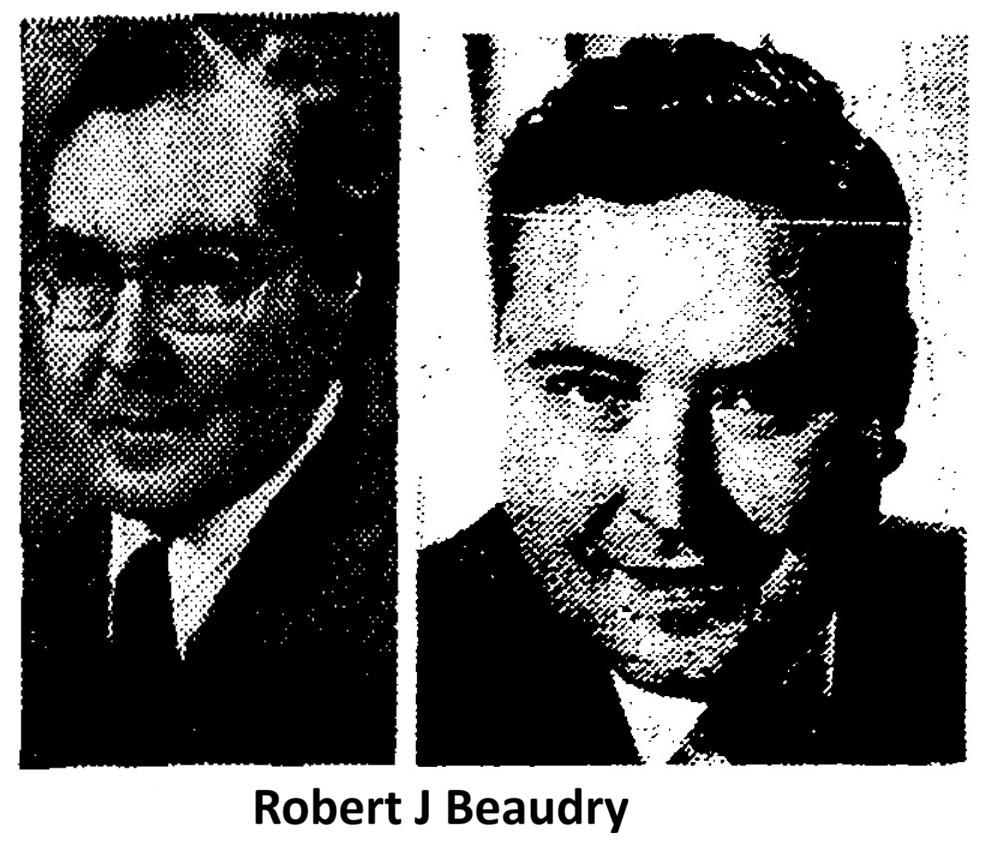
Attorney Robert J. Beaudry was Milwaukee County Democratic Chairman from 1961-1962. He was a former carnival barker.
1964, ran for county supervisor and lost
1966, dissolved his law partnership with Eugene Kershek
- ran for West Allis municipal judge and lost
Beaudry represented Mrs. Evelyn Komarr in 1968. He assisted her in drafting her will on March 18, 1968, and she passed away on July 8, 1968. In fact, Beaudry called in attorney Joseph Balistrieri to draft the will, because Beaudry believed he would be a beneficiary. He was set to inherit $40,000 or $50,000. Balistrieri wrote the will and it was witnessed by his sister, Benedetta Balistrieri. Komarr could not read or write and signed the will with an X.
The will faced objections when entered into probate, with objectors concerned that Komarr “was not of sufficient mental capacity” and Beaudry had undue influence on his client. Beaudry receiving thousands while Komarr’s son George Vargo received nothing was seen as very suspicious.
September 17, 1968: Beaudry spoke publicly, “This old lady was a very dear friend of mine. She looked forward to my taking care of her affairs. She came to our house to eat and at Christmastime. I represented her and her husband for many years. She said she wanted to leave me her estate and I said that if he wanted to do that, I couldn’t represent her. Then she had a stroke and I went to see her and she said again that she wanted to leave it to me. I said I couldn’t draft the will for her, so she said, hire me me an attorney. I’ve known Joe Balistrieri a long time so I asked him if he could handle it and he said he would.”
January 22, 1969: Joseph and Benedetta Balistrieri testified in probate court that no undue influence was put on Mrs. Komarr. Joseph said he read each paragraph of the will to Komarr while she was in her room at Misericordia hospital. “I repeatedly asked her if this was what she wanted and she said yes.” Benedetta testified that she saw the same thing, though added that it was Joe who signed the will with an X while Komarr held his writing hand. Beaudry testified he had been Komarr’s attorney since 1960 when he drafted a will for her leaving her estate to her husband. This will became outdated when the husband, Bruno, preceded her in death.
January 23, 1969: Beaudry testified that before hiring Balistrieri he consulted with Ralph J. Chmurski, a deputy register in probate, in the office of his friend Judge Michael Sullivan. Chmurski testified that his advice was to get another attorney to write the will. “I told hm that anything less than that would invite a challenge,” he said. Vargo’s attorney continued to argue that at the time of the drafting Komarr was not mentally competent. A Wisconsin Supreme Court case from 1963 was also cited, saying it was required “a will be drafted by a disinterested attorney of the client’s own choosing.” Balistrieri was not chosen by Komarr, and was arguably not disinterested.
November 18, 1970: At a court hearing, attorney Roland Steinle (representing Beaudry) challenged Vargo’s prior claim that he was Komarr’s legal son. They turned up records that Vargo had been adopted in 1920 by Theresa Kapitanich (Komarr’s sister) and previous had the name Theodore Kapitanich. They alleged that Vargo had, therefore, previously lief under oath when claiming to be a “legal son” of Komarr.
1971, ran for state supreme court and lost
November 4, 1971: Beaudry defended himself at the Supreme Court from charges of unprofessional conduct. The prosecution said he should not have “hand picked” an attorney for Komarr, but sought the Milwaukee Bar Association for assistance. His attorney, Roland Steinle, said the State Bar Commissioners failed to prove the charges “by clear and convincing evidence.” The State Supreme Court reprimanded Beaudry for the will incident but kept his license intact.
1974, was manager of Albert Castro’s campaign for county party chairman. His literature was so “flamboyant and aggressive” that Castro distanced himself from it. Beaudry told the press, “The purpose (of advertising) is to get attention. The more colorful and dramatic it is, the more likely it is to succeed.”
1975, ran for circuit court judge and lost
June 1975, Jimmy Carter spoke at the Wisconsin Democratic Convention. Beaudry would later claim this was the moment he was “sold” on Carter as a presidential candidate.
Beaudry was elected to Milwaukee County Democratic Chairman on August 10, 1976, by a vote of 86-52. He beat interim chairman Veronica Boehm. Albert Castro took a distant third place. The position was just until December when a full two-year chairman would be voted in. Beaudry campaigned on the promise he could raise money. “I’ve never run an event in my life that didn’t make money,” he told the voters. The party needed cash, as they still owed about $40,000 on a diner they operated at the State Fair Park.
August 25, 1976: Joseph Balistrieri was named to the executive board of the Milwaukee County Democratic Party, appointed by chairman Beaudry. The newspaper said this resulted in “confusion and chaos” by those present at the Stanton Hall (5218 West Blue Mound Road) meeting, if for no other reason than that Balistrieri was not even a party member until that very day. Norman Schomisch got into a shouting match with Beaudry, saying he “personally would be very upset if Balistrieri were made a member of the executive board… The problem is Balistrieri, a member of the party one day and suddenly he is named to the executive board. Maybe he’s a guy who could help raise money, but I don’t know what else he can bring to the party.”
Beaudry defended his pick, saying, “He’s young, bright and able. He’s a court commissioner and has good contacts in the business community. We can use him to expand our political base. He can help us raise money. He’s a successful lawyer. He’s got money and he’s got clients who have got money… Joseph’s a grown man. His father has nothing to do with this. It can’t hurt us getting money, because we aren’t getting any money now anyway.” Beaudry further claimed that other party members “were trying to get Balistrieri to join the party and help with fund raising for some time.”
September 11, 1976: A letter from “JWJ” appeared I the Milwaukee Journal. Among other things, it said, “Being a regular Democratic voter, I was overcome with disgust. While I honestly believe that the relationship of father and son is not always a birds of a feather thing, it certainly won’t help to get out the vote for this coming election.”
September 15, 1976: Balistrieri spoke to the Milwaukee County Democratic Party. He said, “The Balistrieri family has been in Milwaukee 70 years. We came from Sicily. My father was convicted of income tax evasion in a case that stunk to high heaven and is being reopened… My integrity has never been questioned… They had to pick o na dago and I’m a dago. I’m proud of my father. He is not a criminal.” He also pointed out that joining the party late should not be held against him and cited a Bible passage where workers who arrived late to the vineyard were still given a full day’s payment. The board held off on making any official decisions, but Darryl Hanson said the Balistrieri appointment was “a matter of public image which we did not create. He is a fine gentleman and I’m the last to cast a rock. But it is a presidential election year and the voters were upset when they read he was appointed.”
In a brief interview September 22, Balistrieri said, “I want to help the Democratic Party, that’s all. I’ll still be a Democrat” if the nomination is rejected.
October 20, 1976: Beaudry withdrew his nomination for Joseph Balistrieri to serve on the party’s executive committee. Those present at the meeting in Serb Hall “loudly applauded” when he withdrew Balistrieri’s name. Beaudry stood by his choice but said it was more important to unify the party than divide it as they were nearing the 1976 presidential election of Jimmy Carter. Beaudry further said that when party elections came up on December 5, he would not seek re-election as county chairman. He also expressed his disappointment in fundraising, saying he had hoped to raise as much as $10,000 before the November election, but now was closer to only half that.
November 24, 1976: Beaudry reversed course and announced he would seek a full term as party chairman. He was considered a “strong favorite.” The Milwaukee Sentinel noted that Milwaukee Democrats were at a low point – they had better finances and twice the membership 15 years earlier (during the Kennedy presidency).
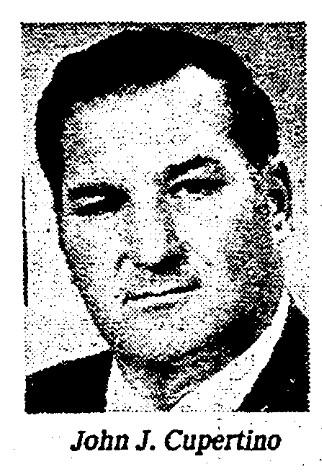
December 5, 1976, five candidates ran for party chairman: Robert Beaudry, John Arakelian, John J. Cupertino, Albert Castro and Michael Jolly. On the first ballot, the results were: Beaudry (98), Cupertino (85), Arakelian (48), Jolly (32) and Castro (22). With no clear majority, a second ballot was done, with Cupertino taking 87 and Beaudry 77 – some delegates left before the second vote, hence the lower numbers. However, even on the first vote, only 294 of 2,700 eligible voters showed up. Party rules required 10% attendance (270) to hold a vote, so they just barely made it. Cupertino, a moderate conservative and manager of the Boynton Cab Company, was declared the winner. Cupertino had favored Henry Jackson over Jimmy Carter in the Democratic presidential primary.
Beaudry challenged the result, saying there were “irregularities,” and arguing he could have won if everyone had voted, but the state party shot him down and seated Cupertino. Beaudry did not accept this and sued on December 15. Judge John Buchen named John Arkelian acting chairman on December 21, saying he wanted neither of the disputed winners to hold the seat until things were sorted out. (Arkelian was appointed because he took third in the vote.)
On February 10, 1977, Judge Buchen tossed Beaudry’s lawsuit and allowed Cupertino to keep his chair. According to party attorney John Arakelian, Judge Buchen said it was an internal problem and not something for the court to decide. (The chairman was a part-time, unpaid position… so why anyone would sue for it is beyond me.)