(As always, this page is intended to be a depository for my notes — it is not claiming to be a cohesive article.)
A reader asked, “Curious if you have come across a Richard Piano in your work. Seems he was a lawyer that represented the Milwaukee Mafia. He lived next door to us in Shorewood for 8 years. Their flagpole out front had an American flag with an Italian flag underneath it flying 24 hours per day, with a light shining up on the flags so as to not be disrespectful at night. Every summer they loaded up the family car and drove to Las Vegas for a 3-4 week trip. They always drove. My parents always remarked that he must have been ‘important’ because his name never ended up in the newspapers or anywhere else apparently. The only other discussion of the Pianos was to not get in fights with them at school. Piano cut his own lawn and trimmed his hedges just like anyone else. Anyway, curious if you ever came across him, perhaps his activities were just neighborhood lore.”
The short answer is that Henry Piano (not Richard) was an attorney with a deep love of his Italian heritage, and as such his life overlapped with the bad elements of the Italian community. He was not, in my estimation, actively a part of anything sinister. But let’s explore a much longer answer…
Part One: Carmelo Stancampiano
Carmelo was born roughly 1896 in Sicily.
July 19, 1917: Pasquale Brisca, who lived on Cass Street with Carmela Pizzino, was shot three times in the head at the corner of Michigan and VanBuren. He was employed as a section boss for the electric company and had only been in the country for five years. Detective John Sullivan told the press that he expected to have two men arrested within 24 hours, as they already had a lead about an argument Brisca had in a bar. Mrs. Michael J. McCann witnessed the killing and could identify the men. Mrs. Pizzino told the press that Brisca “was a good man” and had not been receiving Black Hand letters.
Police picked up 21-year-old Carmelo Stancampiano in Lannon, though he lived on Huron Street. Carmelo told the police that he came to America around 1912 and worked in a macaroni factory in the Third Ward. He met Pasquale Brisca, who was known I the “old world” by his brothers Nick and Tony. Flash forward and Brisca was playing cards with Carmelo and Nick at a saloon. He started talking big about his card skills and a physical fight broke out with Brisca winning.
On the morning of July 19, Carmelo went to his brother Tony’s house to help move. While walking, he saw Nick arguing with Brisca, and then Carmelo stepped in and shot him three times. Carmelo told police he was responding to Nick yelling, “He is killing me.”
The Milwaukee Sentinel reported there had been 16 murders in the Third Ward between 1907 and 1917, not to mention many other acts of violence and non-lethal bombings.
August 4, 1917: Nick Stancampiano showed up at the police station with attorney William Kershaw. He told police he had spent the last few weeks hiding in the woods north of Milwaukee, eats berries and begging for food from farmers. His clothes were ragged. Police held him as a material witness. His story corroborated that of his brother, saying Brisca tried to bite his ear off and spat at him, and then a shot took Brisca down. Nick claimed not to see who fired the shot. Police confirmed that Nick’s ear was “badly torn.”
September 11, 1917: The trial opened at 10:00am and ended at 4:45pm. Carmelo’s attorney, William Kershaw, argued that the murder was in defense. The jury deliberated 20 minutes before finding Carmelo guilty. It was declared the shortest murder trial in Milwaukee’s history. September 15: sentenced to life in Waupun Prison by Judge AC Backus. He was to spend every July 19 in solitary confinement to remember his crime. Carmelo’s brother Nick acted as interpreter for his brother. The day after sentencing, Carmelo was brought to Waupun by Undersheriff Asmuth.
Part Two: Nick Piano
Born in Capo d’Orlando as Cono Stancampiano and came to Milwaukee in 1904 or 1907, sources vary. Presumably, he is the brother of Carmelo. The ages are similar, and Nick does have a brother Tony, just as Carmelo did. I cannot be 100% because no single genealogy record connects them, but Stancampiano is not a common name AT ALL.
In 1930, opened Nick Piano’s Triangle Inn at 1608 North Water Street. (His obituary says 1922, but the 930 date is more often used.) Later claimed he picked up the first barrel of beer from Schlitz when Prohibition ended in 1933. This is plausible, as the bar was two blocks from the brewery. In March 1952, two armed robbers stole $40-45 from the bar.
He operated the Triangle Inn until his death in May 1967 from a cerebral hemorrhage, and his widow Angeline (known as “Mama Piano”) ran it until 1972. She passed in 1977.
When Angeline passed, her obituary identified her children as Philip, Henry and Grace. Grace was actually her stepdaughter. Stepson Charles was not mentioned. Nick’s obituary also did not mention Charles.
Part Three: Henry Piano
Henry George Piano was born in Milwaukee on September 13, 1934 to Nick Piano and Angeline (DiQuardo) Piano. He graduated from Marquette Law in 1957. In early newspaper mentions, Henry is sometimes “Henry Stancampiano,” suggesting the family did not fully change to the shorter name until the 1950s.
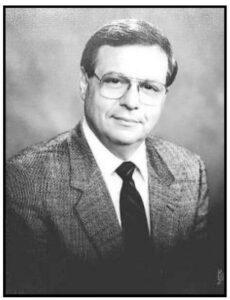
December 1961: Attorneys Henry Piano and Dominic Frinzi co-sponsored a testimonial dinner for Dr. Vito Guardalabene at Gallagher’s (829 North Third Street). Gallagher’s was operated by Frank and Peter Balistrieri, who were in attendance. Seven judges were at the party: Robert Curley, Thaddeus Pruss, Robert Hansen, Harvey Neelen, William O’Neill, Michael Sullivan and Christ Seraphim.
Other notables present were: city attorney John Fleming, court clerk Raymond Fleming, sheriff George Witkowski, deputy district attorney Aladin DeBrozzo, county supervisor Joseph Greco, city civil service chairman Angelo Provinzano, Teamsters leaders Frank Ranney and Roy Lane, hotel union leader Phil Valley, and bartender union leader Ben Barwick.
And still more guests: convicted murderer Louis Fazio, fraudster August Maniaci, fence Harold Klein, former Mafia boss John Alioto and president of City Bank and Trust William Frank.
There is nothing about this party that suggests any wrongdoing by Henry Piano, but there are a few names that raise eyebrows, as well as the choice of venue. Later rumor (I don’t think this can be confirmed) was that this same party doubled as a celebration of Frank Balistrieri’s “coronation” of Mafia boss.
July 1963, federal marshals attempted to seize furniture from Gallagher’s. Dominic Frinzi was there at the time and called Henry Piano, who he said was Peter Balistrieri’s attorney.
Joseph and Frances Maniaci signed the articles of incorporation for Mando Enterprises on June 8, 1965, in front of notary public Henry G. Piano. Joseph was president, Frances was vice president and Ann Porath was secretary-treasurer. For a brief time, James Jennaro was also a director. (Ann Porath seems to be the married name of Ann DiGiorgio, the sister of Angelo DiGiorgio.)
Joseph Balistrieri (son of Peter) and Mary Balistrieri, both of 1634 North Jackson Street, signed the articles of incorporation for Bals, Inc (the corporation that owned the Scene nightclub) in front of notary public Henry G. Piano on June 24, 1965. Throughout its existence, Bals, Inc was a three person corporation — Peter served as president, Mary as vice president and Joseph as secretary-treasurer. The real owner of the Scene (formerly the Swan Theatre and Supper Club) was, of course, Frank Balistrieri.
Frank Balistrieri filed a mortgage on October 25, 1965, conveying the property at 3043 North Shepard Avenue to Frank Ranney for the consideration of $10,000. The mortgage was prepared by attorney Henry G. Piano.
January 1974: Piano was appointed a court commissioner for Judge Louis J. Ceci.
December 1977: he purchased an apartment building at 1646 North Prospect from disgraced attorney Sydney Eisenberg for $1.2 million. Piano’s business partner in this was Sam Cimino. (Cimino is unknown to me… but another Cimino had the license for Snug’s.)
June 1979, Piano was attorney for Frank Balistrieri when he was picked up for beating his mistress.
In a November 1980 article on fathers and sons, Henry said, “I always thought my father was the greatest man in the world. My greatest hero was my dad. Although he had only a third grade education, he was probably the most brilliant man I’ve ever known. He never ceased to amaze me. When you consider that he came to a country where he couldn’t speak the language and had to learn how to do it – he told me it was very difficult because many people made fun of him when he came here. He overcame a lot of prejudicial obstacles, but he always said there was no place in the world where you could overcome prejudice like you could here with good hard work.”
He continued, “Because he had such an inquiring mind, he had a tremendous reverence for education. He told us that when we grew up it was our chance to get into what he considered the mainstream of American society, something he felt he couldn’t get into outside of the business community because of what he considered his limited education. He was a very affectionate man. I mean I kissed my dad every day of his life. I saw him and my mother every day of their lives, if I had to stop at 11:00 at night. We loved each other so much, we were just a very happy family. My dad was firm, but as firm as he was, that’s how loving he was. He’d cry at the drop of a hat.”
In conclusion, “You know he was the last word in the house – well, he thought that, but like all Italian families, my mother was probably the last word. But she never tried to countermand what he said in the presence of the children. And you know a lot of what he said was right. It was a different era, but I try to do that myself now. I try to imitate my father in raising my kids, but I’ll never do as good a job as my father did. There are many times when I know Nicky gets upset with me because I insist on things being done in certain ways and insist on a certain amount of discipline and self-discipline.”
1981: was attorney for Rudolph Porchetta in a false swearing trial after Joseph Balistrieri withdrew. For part of the trial, John Balistrieri was co-counsel.
November 1983: Phil Purpero was appointed executive director of the Italian Community Center. Other officers were: president-elect Anthony Cusatis, first vice president James Spataro, second vice president Henry Piano, financial secretary Sam Balistreri and treasurer George Menos.
August 1984, Piano was asked about Italian husbands. He “is a man who is firm in his convictions, is a loyal and loving husband and a good and firm father who heads the family with dignity and pride.” The wife “is a great mediator in family disputes and probably makes the decisions anyway, although he thinks he did.”
May 31, 1985: The newspaper said representatives of the ICC donated to Governor Tony Earl. Piano wrote a letter expressing concern, saying it was true that ICC members had donated, but wanted to stress it was personal and not as the ICC. The organization, by its own bylaws, was non-partisan.
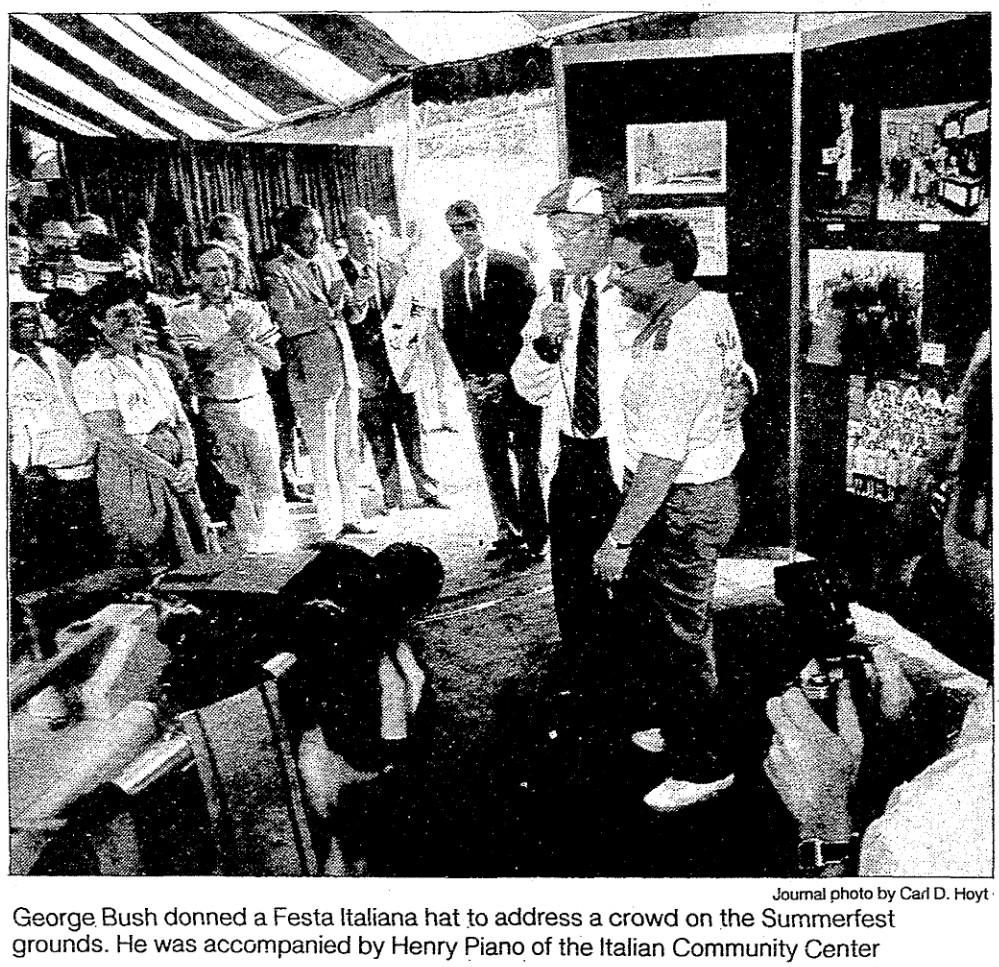
November 1986: Anthony Cusatis (general manager of Gimbels) was named the first full-time executive director of the Italian Community Center. The position was created to oversee construction of the new center at the Coachyards, purchased from Milwaukee County. Henry Piano was named president, which he held at least through August 1987.
July 1988: Piano was host to Vice President George Bush at the Italian Community Center.
November 1992: George Menos (account manager for TMP Worldwide) was named president of the Italian Community Center. Dominic Frinzi was named president-elect, attorney William Jennaro was first vice president, Henry Piano was second vice president, Josephine Colombo was financial secretary, Sam Purpero was treasurer, Anna Pitzo was recording secretary, Ann Skoczynski was corresponding secretary, and Louis Aveni was sergeant-at-arms. Directors at large were: Sam Balistreri, Mario Carini, Mary Smith, Rosario Spella, Vincent Emanuele, Anthony Maida and Jack Costa.
Henry Piano passed on October 25, 2020 at his home, age 86.