In the Milwaukee Mafia book, boss Joseph Vallone only comes up in passing – he is mentioned only three times, and pretty much only indirectly. There is nothing of his biography in there. A podcast listener asked me, “Was Joe Vallone at the 1928 Cleveland Mafia Summit? If not, why not?” This seems like a good time to explore this.
Giuseppe (Joseph) Vallone was born in Prizzi, Sicily on September 7, 1884. Perhaps because of his common name, I was unable to find who his parents were, and thus any close relatives he would have had. I have checked over 430 records from Prizzi and other names include: Collura, Damiano, Ferrara, Fucarino, Macaluso and Migliaccio. In Milwaukee, the majority of Mafia members were from Santa Flavia, but a sizable minority were from Prizzi. This does not seem to have caused much tension, despite Sicilians tending to have loyalty to their hometown.
Prizzi is about 49 miles south of Palermo in the same province. It is a mountainous and agricultural area known for cattle, sheep, and horse breeding. In the late 1800s and early 1900s, the criminologist Cutrera stated that Prizzi had a “greater density” of Mafia. In Rebels and Mafiosi, author James Fentress stated that the area was notorious for “livestock theft.”
On June 15, 1907, Vallone married Mattia “Martha” Fucarino in Prizzi. They were likely distant cousins, but I don’t know that.
On October 8, 1907, Vallone arrived in the United States aboard the S.S. Citta di Torino with seventeen-year-old Giuseppe Mari. Their final destination was to their “uncle” Giorgio Lercara in Milwaukee. (Lercara is not a name I know, and not on my Prizzi list – more likely this was very sloppy penmanship for Ferrara.) Oddly, his wife did not join him until May 7, 1912. Perhaps he wanted to raise money and establish himself before sending for her.
According to the April 1910 Census, Vallone and Pasquale Migliaccio, another immigrant from Prizzi, were both living as boarders at 256 Milwaukee Street. All men living at this address were stated as laborers, working “odd jobs.” During the mid-1910s, Vallone and Migliaccio both lived at 137 Buffalo Street. Vallone worked as a teamster for the City of Milwaukee.
In the mid-1910s, Nicola Gentile, a Pittsburgh Mafia leader at the time, had a Milwaukee meeting and successful Chicago trip with Vito Guardalabene and underboss Joseph “Piddu” Vallone. He later wrote: “I then went to Milwaukee, place of residence of Vito Guardalabene, a native of
Porticello, Bagheria, my old friend, rather advanced in age, venerable in appearance and a descendent of an illustrious family. I told him of the unfortunate case of (Mafia member) Paolino (not further identified) and of my intention of going to confer with (Chicago Mafia boss Anthony) D’Andrea. He had no hesitation: “Only you can save him; nevertheless I will go with you.” Even the vice-capo of the borgata, Piddu Vallone, joined us, excited about the good deed we would do. We left for Chicago and, on arrival, we took accommodation in a hotel.” The Chicago trip was a success.
This has us ask: When did Vallone join the Mafia? At around 30 years old, he is already identified here as the underboss of the Milwaukee Mafia, a seemingly high rank for such a young man. Unless he went straight to underboss (unlikely), Vallone had likely been inducted some time ago. He had been in Milwaukee perhaps a decade. Was this enough time to join and go up the ranks? Or was he already inducted in Sicily at age 18-20? I find it very unlikely Guardalabene would have known Vallone in Sicily. We, of course, will never know.
Around 1917, Vallone formed wholesale grocery company Migliaccio and Vallone with business partner Pasquale Migliaccio They took over the grocery store at 161 Detroit that had been run by GB Guardalabene 1913-1917. Joseph Burgarino was also briefly a partner – Migliaccio’s wife was a Burgarino, and other Burgarino relatives by marriage were Mafia members Sam Ferrara and Joseph Gumina. This building was center of the Third Ward, with immediate neighbors Vito Guardalabene and Carlo DiMaggio. The firm would later change its name to Pioneer Food Company.
What sparked this deep dive on Vallone was a reader/listener question: was Joseph Vallone at the 1928 Cleveland Mafia summit, and if not, why not? The meeting is believed to be a nationwide gathering of Mafia members following the rise of “Joe the Boss” Masseria, the “boss of bosses” in New York. Indeed, those known to be there because of police intervention were numerous men from New York, Cleveland, Chicago, St. Louis, Buffalo, Tampa, etc. If Milwaukee was an independent family, it seems fair that a representative would be there. Masseria’s rise was a major event nationally, indirectly leading to the ascent of Al Capone.
World’s leading Mafia expert Tom Hunt wrote in 2010, “Evidence suggested that the police action occurred before all expected attendees had even arrived in Cleveland. Police found reservations for suspected gangsters at a residential hotel on the city’s East Side. Officers were stationed at the hotel, but the anticipated guests never showed up… If Mafiosi were gathering in Cleveland to recognize Masseria as new boss of bosses, one hundred or more underworld figures should have been in attendance, meaning a large majority of convention attendees managed to avoid arrest either by finding less noticeable accommodations than the Hotel Statler or by scheduling arrivals after the December 5 arrests.” Was Vallone expected to attend? We could not know for sure, but it seems likely he – or some Milwaukee man – would have gone..
The first mention of Vallone I could find in the newspaper wasn’t until June 15, 1930. It’s possible he appeared earlier under a bad spelling, I haven’t found the right newspaper, or just as likely he was not written up in the English language newspapers when his first language was Italian and he lived among other Sicilian men. The June 15, 1930 Milwaukee Sentinel mentions that 100 Milwaukee Italians were taking the train to Ironwood, Michigan for a combined meeting of all the different Italian clubs. The convention lasted three days, featured a parade and boxing matches between “Italian giant” Primo Carnera, Jack Lewis and Harry Creighton. The article refers to Joseph Vallone as a “well known resident” along with Pasquale Migliaccio, Matt Delsano and Charles Asti.
The delegation was lead by GB Guardalabene (president of Madonna del Lume) and Alfred Sanfilippo (vice president). Presidents of the represented socities were: Frank Balistrieri (Principe Umberto Society), Domenic M Giuli (Francesco Grispi), Joe Spagnolo (Cristofo Colombo Society), John Alioto (San Pietro group), Joe LaBarbera (Regina Elena society), Sam Patti (Vespri Siciliano organization), Ben DiSalvo (San Giuseppe Society), Anton Campanile (San Rocco Society), John Busalacchi (Duca Degli Abruzzi Society), Joe Tocco (Dante Aligheri Society) and Mrs. Melina Badolati of the Eleonora Dude group.
May 1931: The Milwaukee County Italian-American alliance was formed at Romano’s Hall, with a goal of signing up 1,000 members. Officers chosen were: Sal Sanfelippo (president), James Sammarco (vice president), Christopher Canepa (secretary), August Balistrieri (treasurer), and Anthony Cefalu (financial secretary). Trustees were: “Giuseppi Valloni,” Pasquale Migliaccio, Frank Balistrieri, John Alioto, Angelo LaMantia, Giuseppe Tocco, Salvatore Aiello, GB Guardalabene and Salvatore Patti. The goal was to promote the social welfare, education and cooperation among the Italians in Milwaukee.
Around June 1932, Vallone was scooped up as 1 of the 45 people said to be involved in a massive bootlegging ring. Vallone (whose address was given as 421 East Buffalo) was suspected of using his position as a grocery merchant to supply sugar to the bootleggers. Other notable Milwaukeeans arrested were night life character Jack Phillips, Third Ward leader Angelo Guardalabene (and proprieor of the Monte Carlo cafe), fight promoter Albert J. Tusa of the Arcadia Athletic Association, Tusa’s secretary Marian Jezo, liquor runner Jack Barber, bootlegger Ralph West and his wife Bea Banks West, bootlegger (and hops dealer) Joe Pessin, malt store operator Sam Holzman, Erwin Lueke (or Edward Luke) and L.E. Chapman of Fond du Lac, Herman Ciccini of Sheboygan, George Williams of Appleton, cattle dealers Sam and Heine Wainer of New London, and Joe Domanik of Racine. Tusa told the press, “I can’t understand it. I’ve never been in the racket and never been in any kind of trouble with the federal government. This whole thing is hurting my family and my business.” He said he suspected he was “drawn in” because of friendships with Guardalabene and Vallone.
Four defendants pleaded guilty in December 1932, paying fines of $2,750.
The case continued on with arraignments pushed off until February 6, 1933 and federal judge Robert C. Baltzell of Indianapolis sent to preside in Madison. (The delay was due in part to the Madison federal judge, Claude Luse, dying and not being replaced.) Bizarrely, Pessin had retained Levi Bancroft as his defense attorney – Bancroft had been a US attorney and was the one who sent Pessin to Leavenworth.
October 23, 1933: Judge Patrick Stone, presiding at federal court in LaCrosse, handed fown fines totalling $6,650 against a handful of defendants. Albert Tusa was fined $1,000 and given 15 days to pay. Angelo Guardalabene was fined $500, placed on probation for 8 months and given 6 months to pay. Joe Pessin, recently released from Leavenworth, was fined $300. Bea West was given six months probation, while her husband was still missing. Jack Phillips, who had bribed a policeman to let a truckload of beer go through, was fined $300 and six months probation. Jack Barber was given eight months probation (but no fine). Sam Holzman was fined $300 and given 8 months probation. Peter Piscitello (spelled “Pischettlo” in the newspaper) got six months probation.
At the same time, the cases against Vallone and Jezo were dismissed. Four more Milwaukeeans had no even been arraigned yet: Don Reid, Ralph Lyons, Fred Kvalshaw and the missing West, who was beleived to be the “ringleader” who maintained a fleet of trucks to transport booze. West was allegedly “closely allied” with Harry and Leo Feinberg of Baraboo. West would bring alcohol to Baraboo, and the Feinberg brothers would ship it to Minnesota and South Dakota.
Another two (Joe Howard of Cudahy and Cecil Grover of LaCrosse) were scheduled to go on trial November 16, 1933. (This case will be explored in more detail on our sister podcast, Fox Cities Murder and Mayhem.)
In 1933, Vallone and Migliaccio opened a second business, the Broadway Liquor Company.
September 1933, the Casa Italiana Columbo of Milwaukee was incorporated with its original meeting place at 631 East Wisconsin Avenue. The purpose was to sponsor lectures, musicals and cooking lessons for the Italian community. Incorporators were John Busalacchi, FA Maisano, I. Castagna, B. Zaffiro, Joe Vallone, Dominic Germanotta, Tranquillo Angeli, Louis Micheli and Federico Gentile.
A 1934 informant identified Vallone as Milwaukee’s “big boss” with GB Guardalabene as second in command, and others of importance being Mike Mineo, Frank LaGalbo and Andrew DiSalvo (of Racine). This is most likely generally accurate, if not exact – LaGalbo and Mineo would both be identified as serving under Vallone in 1937.
On May 31, 1936, the Italian-American Alliance celebrated a six year anniversary at the Hotel Schroeder. 500 people were expected to attend, with toastmaster being assistant district attorney Aladin DeBrozzo. Vallone was treasurer of the alliance. Other officers were: Frank Balistrieri (president), Ignatius Costa (vice president), Nino Cefalu (secretary), Louis Panella (financial secretary), Michael DeStefano (vice secretary) and Nunzio Maniaci (chairman of the dinner committee). Joseph Bruno assisted with setting up the dinner. (This Frank Balistrieri is likely “our” Frank’s uncle.) (Nunzio Maniaci is almost certainly “Pops” Maniaci, father of August and Vincent.)
January 1939, elections were held at the Columbus Center (Casa Italiana Colombo) with the following results: Frank Balistrieri (president), Frank A. Maisano (vice president), Joseph Vallone (second vice president), Nino Cefalu (orator), Ignatius Costa (secretary), Steve Carini (assistant secretary), Federico Gentile (financial secretary), John Alioto (treasurer), Michael “Danish” Dentice (sergeant-at-arms), FJ Basile and Ted Crivello (auditors), and Italian consul Angelo Cerminara as honorary president. Michael Danish was brother to Jack Dentice, a mafioso murdered in 1937.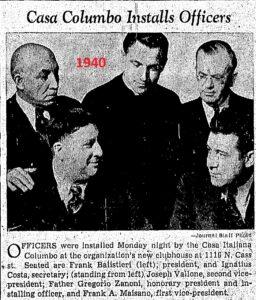
January 1940, Casa Italian Colombo installed officers: Frank Balistrieri (president), Frank Maisano (vice president), Joseph Vallone (second vice president), Ignatius Costa (secretary) and Father Gregorio Zanoni as honorary president.
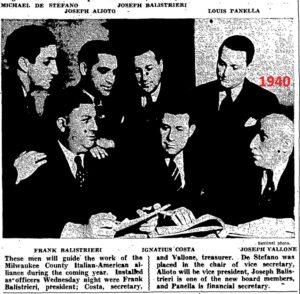
January 10, 1940, the Milwaukee County Italian American Alliance installed lofficers: Frank Balistrieri (president), Joseph F. Alioto (vice president), Ignatius Costa (secretary), Michael DeStefano (vice secretary), Louis Panella (financial secretary), Joseph Vallone (treasurer) and Charles Zarcone (sergeant at arms). Board members were: Joseph Balistrieri, Pasquale Migliaccio, Joseph Bruno, NS Maniaci, Leonard DeStefano, Salvatore Aiello, and FA Maisano. Delegates to the Casa Italiana Colombo were: Joseph Vallone, Joseph Bruno and Ignatius Costa.
March 1943, several Italian leaders met at the Columbus Center (1119 or 1419 North Cass) to support the reelection of Judge Michael Sheridan. Those president were Ignatius Costa (president of the Italian-American Alliance), Frank Balistrieri (president of Columbus center), Joseph Vallone (vice president of the center), Joseph Sciortino (president of St. Joseph Society), Charles Balistrieri, Ray Markey, Rocco Corragio and GB Guardalabene.
September 1944, the OPA sued Migliaccio and Vallone (426 North Broadway), accusing them of charging prices higher than allowed under OPA rules. They asked that the grocery firm pay a fine three times the amount of overcharging. They settled the suit in December by paying $930.
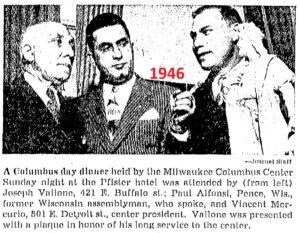
October 1946. the Columbus Center had a Columbus Day dinner at the Pfister Hotel. President at this time was Vincent “McGurk” Mercurio, who presented a plaque to Vallone for his years of service. Guest speaker was Paul Alfonsi of Pence, a former state assemblyman. (Mercurio was a Mafia associate, if not a member, and was uncle to August and Vincent Maniaci.)
Vallone retired in 1949, passing the reins briefly to Sam Ferrara (1949-1952). He died in March 1952 at age 67 from a “heart ailment.” Surviving him were wife Martha and daughter Antonina (wife of Michael Joseph DeStefano, not known to be a Mafia member). He was buried in Holy Cross Cemetery.