James Catania was born October 11, 1915 in Reading, Pennsylvania to Carmelo and Marianna Rifici Catania. A later article would say, “When he was 5, after his parents died, James moved to Milwaukee to live with his oldest sister and her husband.” Another article suggests he was in an orphanage until his sister was old enough to take care of him.
The exact truth may be hard to discern, but the records tell a slightly different story. Marianna Catania DID pass when James was young, but his father did not. In fact, Carmelo Catania moved to Milwaukee just like his children did. The 1920 census, however, does show 5-year old James, his father and a few siblings living with Carmelo’s sister Joanna DeLorenzo and her family. The 1930 census has 15-year old James living with his sister Sarah Germana and family. I have reason to suspect this family was distantly related to the Piscuine family and Sally Papia in Milwaukee, but I can’t confirm this.
Even as a kid, James Catania had a big nose. He liked to joke, “I never wore a baseball cap when I played ball because my nose was bigger than the peak on the cap.” He was a dead ringer for comedian Jimmy Durante.
After high school, he briefly worked in a tannery, but preferred the bar life. When he began tending bar, Catania brought along his larger-than-life personality. By 1945, ads for the Lion’s Den, a nightspot at 533 East Center Street, were touting his stage name “Jimmy Mortell – Singing Bartender.” He later explained that “Mortell” was taken from “tell more,” as in “Jimmy, tell us more stories.”
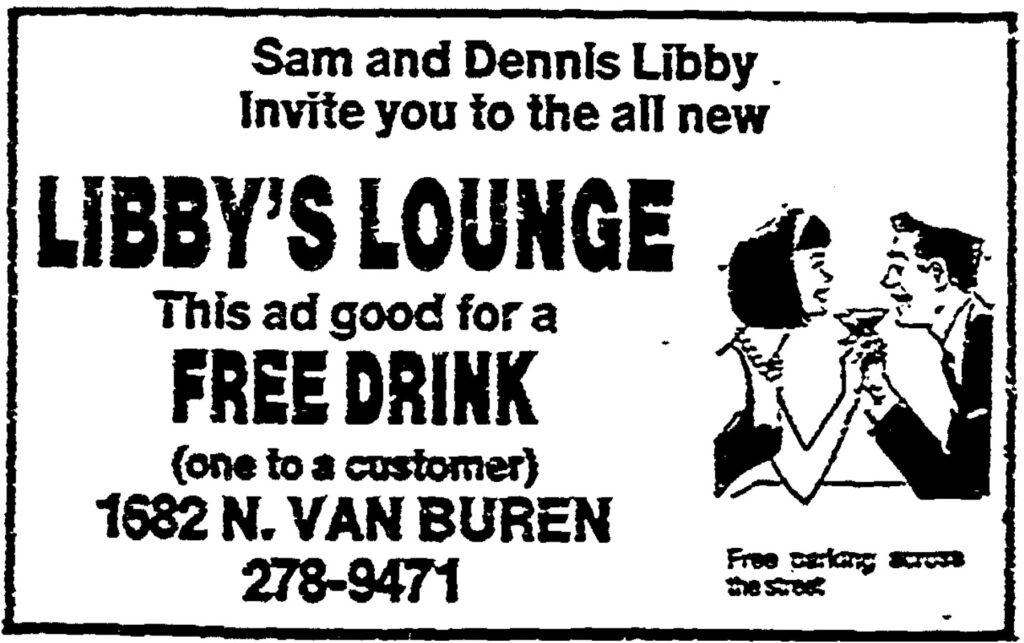
In 1949, he bought his own place. Mortell’s Cocktail Lounge, 1682 North Van Buren Street, became a nightlife mainstay on the lower east side, with Mortell as ringleader. “When the spirit moves him, he will burst out into a Durante song from behind the bar, or sometimes leave the bar completely unattended and walk around to the customer’s side of the mahogany singing loudly,” journalist Fred Schnell wrote.
“I do these things just for the fun of it,” Mortell said. “I like being a character and making people happy.” The federal government saw it differently. The IRS began assessing an entertainment tax on Mortell’s bar, arguing his clowning constituted a cabaret act.
Mortell took the feds to court. The two-day trial in May 1963 made headlines, especially when Mortell took the stand. “I tell ya, coach, even if I lose, I still got my nose. They can’t tax that,” he told the Sentinel. The jury sided with Mortell. Contacted in Hollywood, Durante himself said, in a story published May 30, 1963: “I would have released him, too. The jury must have considered him a pretty bad entertainer.”
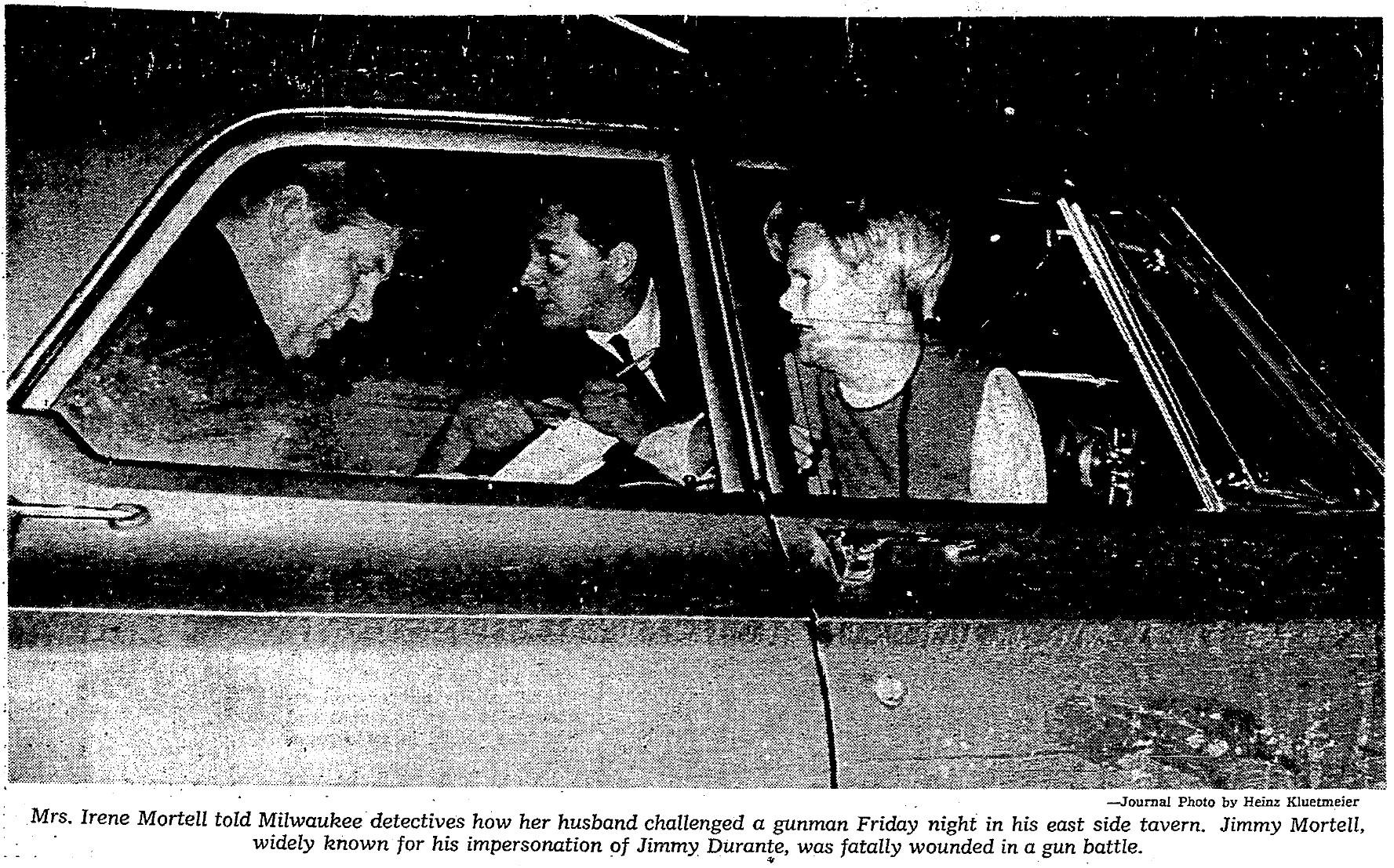
On the night of March 8, 1968, Mortell’s wife, Irene Lentz Catania, was alone in the bar on Van Buren Street when Rodney Charles Hylo, 33, came in and ordered a beer.
As she rang up the sale, Hylo pulled out a gun and told her to give him all the money in the register – about $40. Just then, the phone rang. Hylo told Irene to answer it but not let on about what was happening. The person on the line was one her daughters, Mrs. Salvatore Sciortino; after speaking briefly, instead of hanging up, Irene left the phone on the bar so her daughter could hear what was going on.
Sciortino called her father, who was at the couple’s flat a few doors down. Mortell grabbed his .38 revolver and dashed to the bar. He briefly stopped next door at Antone’s Piano Lounge and told Anthony Germano to call for help. Then Mortell entered his tavern. “Put up your hands or drop the gun,” Mortell told the robber. He then fired, injuring Hylo, who fired back. Mortell, shot in the forehead, was pronounced dead at County General Hospital. He was 52.
Hylo spent more than two weeks in County General in critical condition. Upon release, he was held on $60,000 bail by Judge Christ Seraphim. He later pleaded guilty to a reduced charge of second-degree murder, and told the judge he had been drinking heavily – vodka, wine and beer on that day. The holdup was a spur of the moment bad decision, and the murder was an accident – he only fired after Mortell fired first. Hylo was sentenced on July 23 to 25 years in prison by Judge Robert Curley, on top of a consecutive five-year prison term for armed robbery. Hylo had no previous criminal record.
Irene, Mortell’s widow, briefly retained the license for the bar after her husband’s death before moving to Rockford, Illinois, where she died in 1999 at age 83. By 1970, the bar was operated as Libby’s Cocktail Lounge by Sam Librizzi, a gambler nicknamed “The Book.” (We have covered him elsewhere.)
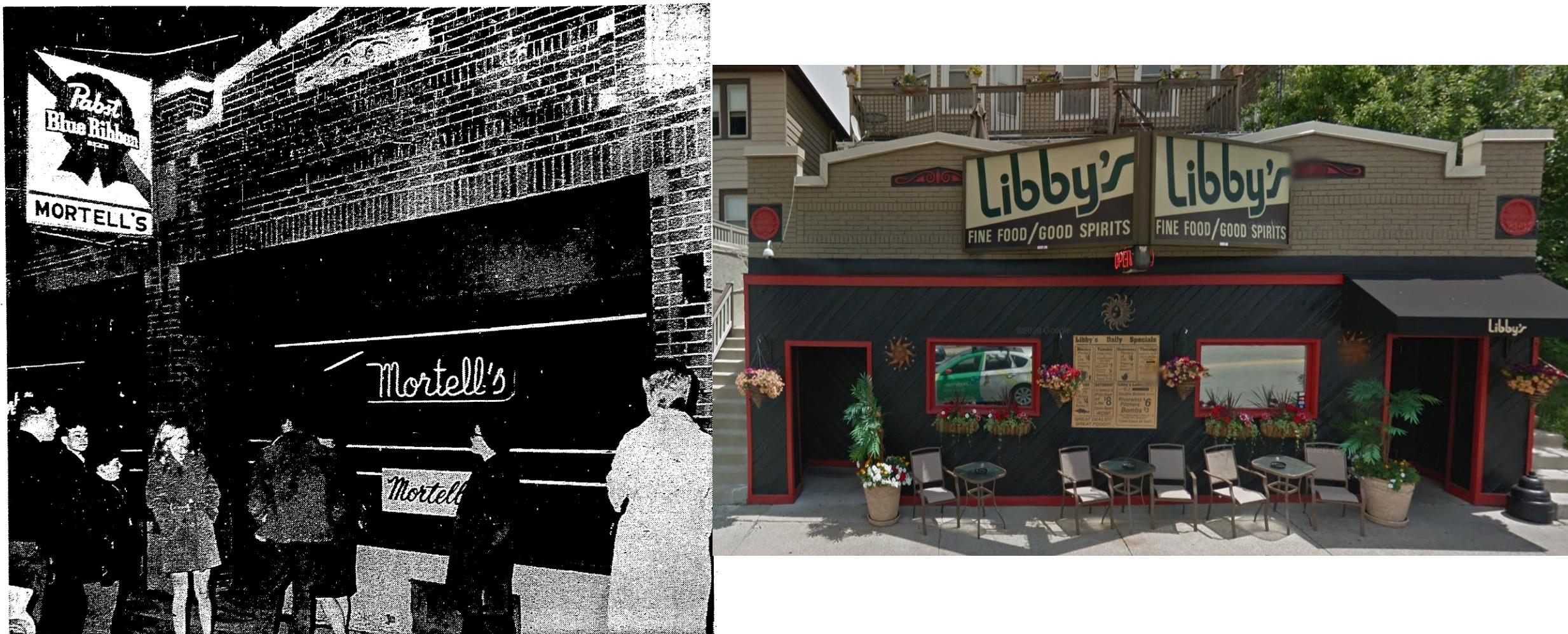
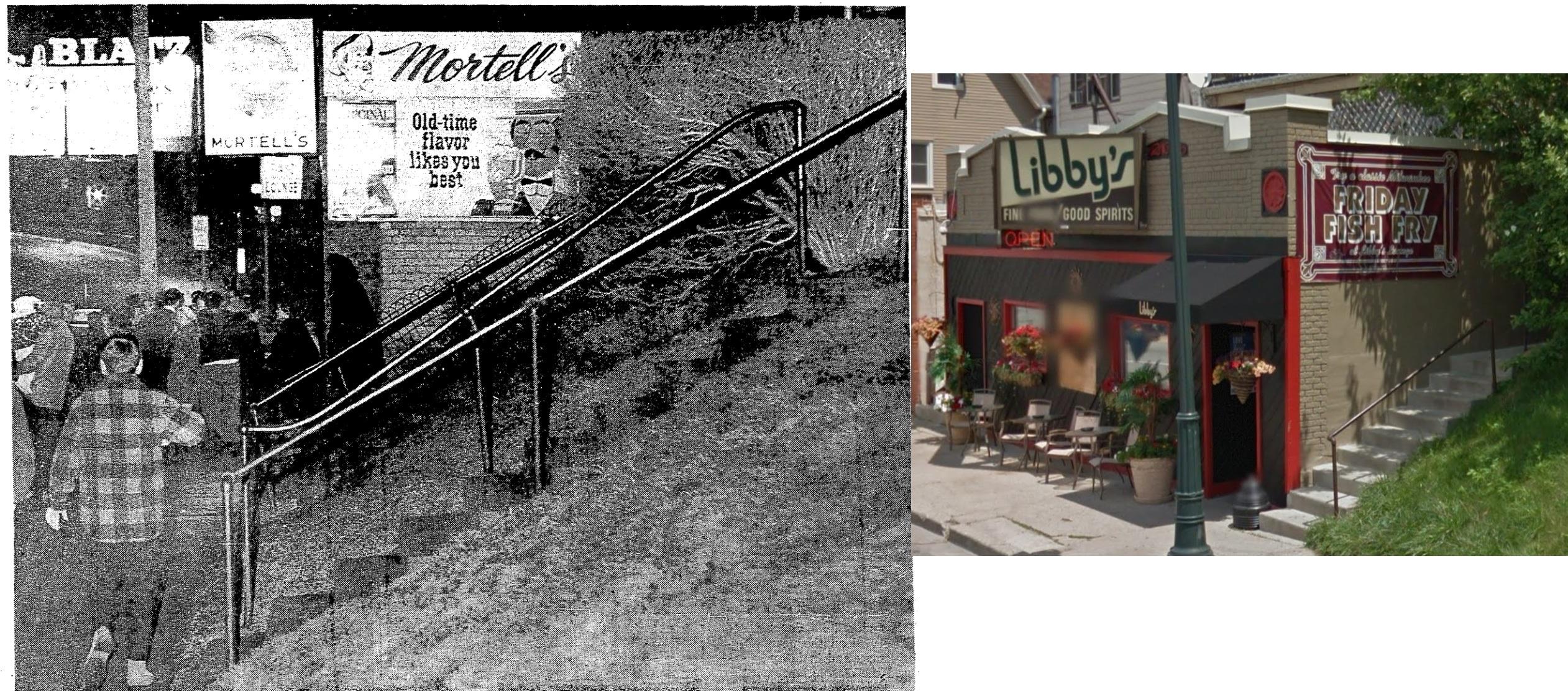
On June 4, 1970, an FBI informant said Libby’s (346 North Broadway) was run by Sam Librizzi and August Palmisano and was a hangout for gamblers. The same gamblers who went here also hung out at Dan’s Restaurant on St. Paul Avenue. Libby’s Lounge on North VanBuren (formerly Mortell’s) was another hangout, and was operated by Sam’s son (also named Sam) and nephew Charles. The Broadway location had the bigger gambling reputation, but there was definite overlap. The elder Sam Librizzi died at the Veterans Administration Hospital in 1970.
On February 19 or 20, 1973, Charles S. Librizzi, identified as the 25-year-old owner of Libby’s Lounge (who lived nearby at 1682A North VanBuren), died after playing Russian roulette in the bar with 26-year old bartender Jack Ittner and two patrons. Ittner told authorities the gun, a five-short .32 revolver, belonged to Librizzi, and the players took turns shooting dice to see who would have to fire the gun. Ittner said he “won” round one, hearing the gun click, but round two was Librizzi, who lost. The other two patrons were identified as 22-year old Emil Doerr of Chilton and 22-year old Ann Riegert of 2920 North Farwell.
Librizzi was high on narcotics at the time. An informant told the FBI that just prior to his death, he was gambling with others at a tavern, including bowler Carl Muccio, playing a form of Russian roulette. He would use one bullet and spin a revolver cylinder and then shoot the ceiling – this version makes it unclear if the gun was supposed to be pointed at anyone. Those present would bet $10 on the outcome. According to my sources, the suicide may have been an accident. The gun used was known to jam and Librizzi may not have believed that the gun was capable of firing.
The FBI informant, though not the newspaper, identified one of the patrons as Hall of Fame bowler Carl Muccio (1947-2020). Was he actually there? Don’t know, but interestingly his mother was a Germano, the same family who ran the bar next door to Libby’s.
The Librizzi death was looked at by Deputy Medical Examiner Warren Hill, who declared at the end of April that it was an accident and not intentional or murder. (I requested the police file on this and it did not exist – probably destroyed. I have not requested the medical examiner report.)