William Dean Tabor was married in the mid-1960s to Janice Brown and soon after entered a seminary in Springfield, Illinois for the Lutheran Church – Missouri Synod. He became disillusioned with some of the theology, and completed his schooling at a seminary for the Lutheran Churches of the Reformation, a more conservative branch of the Lutheran faith.
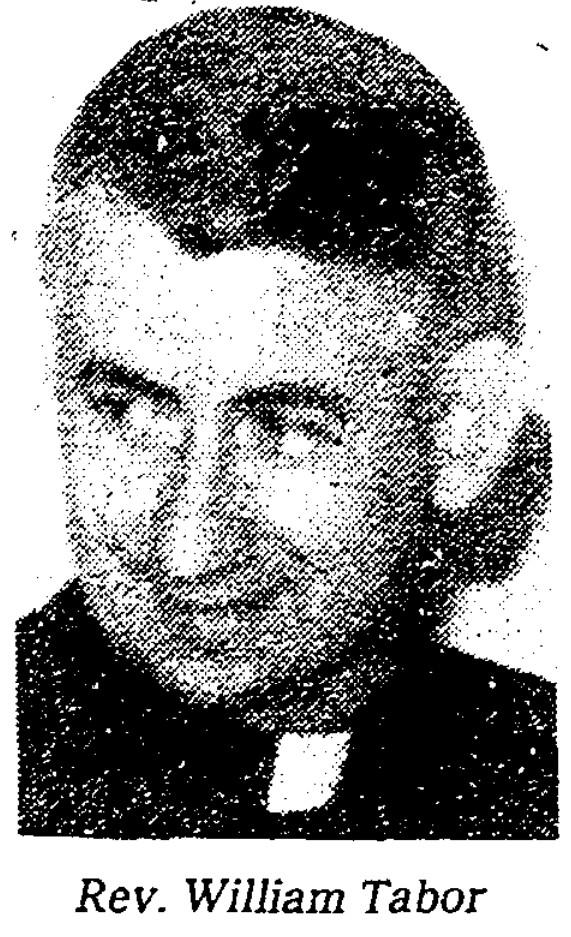
In the early 1970s, William D. Tabor was a pastor at Cape Girardeau, Missouri. Allegedly he fathered a child there with a mistress and left this branch of Lutheranism (Lutheran Churches of the Reformation, LCR) and was taken in by the Wisconsin Evangelical Lutheran Synod (WELS) branch. (Both are considered conservative Christian groups, but have some belief distinctions.)
Tabor was made the pastor of Salem Evangelical Lutheran Church (2400 North Cramer) in July 1973. This was a modest church with a congregation size of 200 members.
Summer of 1976, two of the three Tabor children were married.
On the morning of October 8, 1976, William was at a farewell party at the Benjamin Health Care Center (2115 East Woodstock Place) while his wife was shopping at Northridge Shopping Center. The party was for Tabor, who was being moved to a church in Escanaba later in the month.
Janice M. Tabor, 39, was shot at some time between 10 and 11am while on her basement stairs at 2412 North Cramer Street (the parsonage connected to the church). Three shots from a .45, any of them capable of being fatal, were in her body – entry wounds in the forehead, the lower back and the back of the head. She was found around 1:40pm by her husband and his friend, Janet Ester “Jan” Goodall, an activity director at the health care center. A bedroom in the home had also been ransacked. The pastor apparently did not realize the seriousness of what happened, as he told 911, “My wife fell. I need an ambulance.”
The Tabors had three children: Jay, who lived at home; Randy, who was in the Navy; and Debbie Frick, who was married to a pastor in Illinois. (Where was Jay at the time?)
Medical examiner Dr. Elaine Samuels said, “It seems likely that she was shot twice while she laid on the floor.” No powder burns were found, meaning the gun was at least two feet away when fired.
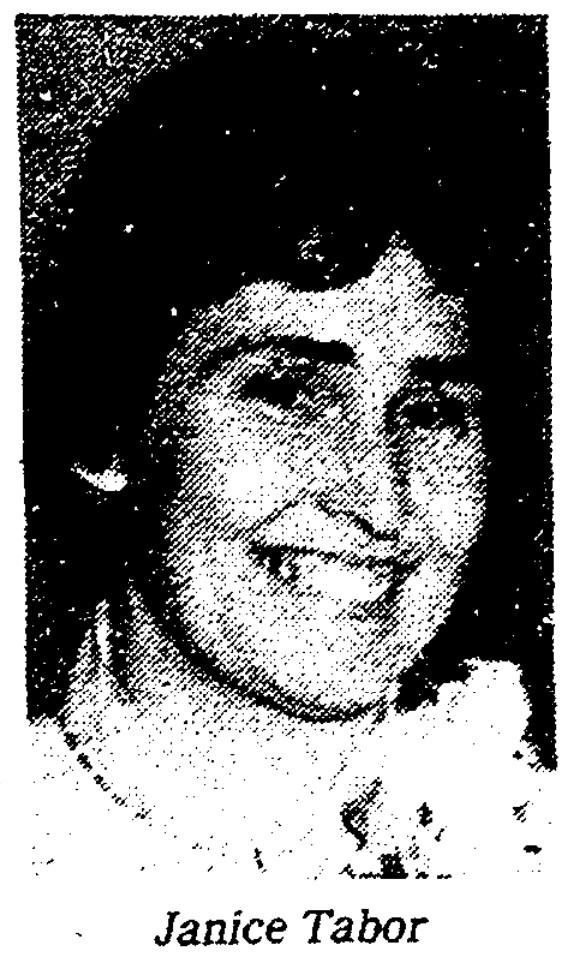
Fred Schuettke of the church said of Janice, “She was a charming woman whom everyone liked. She was charming to talk with, but she was not the type to strike up a conversation. She was more in the background.” Gladys Shelley commented, “She was a really sweet person. Whoever did it had to be a cuckoo bird.”
A suspect was taken into custody around 7:00pm and held overnight for questioning. Not publicly identified, he was released the next morning. The reason? A vial of pills prescribed to him was found in the house, but he successfully explained he lost the pills a week earlier at Century Hall (2340 North Farwell). No one seemed to know how they ended up in the Tabor home.
On the Sunday following the murder, Rev. Ralph Westendorf filled in for Tabor, though he was in attendance. He gave a sermon with reference to the Book of Job, and how even during tragedy we must give praise to God and look to our blessings – what he had, what we have and what we will have in the future. He said a Christian responds to tragedy with thanksgiving, humility and confidence and, “Our tears of sorrow should be mingled with tears of gratitude.” Humanity has no right to anything and we have only what God has given us.
By October 13, police began looking into the idea that the killer was someone known to Janice. Originally the theory was that she startled an intruder, but the lack of forced entry and nothing of value being stolen raised some doubts. (Later it was found that wedding rings and $100 was gone.)
As planned, Tabor moved to Escanaba at the end of October.
The news went quiet and the case seemingly went cold. Checking in six months later (April 1977), the Milwaukee Journal asked about a grand jury. Deputy district attorney Lee Wells said, “A grand jury, at great expense to the community, would have virtually no likelihood of success at this time. The matter continues under review for action at a more provident time as the evidence may warrant.” Lt. Carl Ruscitti doubted the burglar idea saying, “Drawers were pulled out, but it was too orderly for a burglary. The moves didn’t look like a burglar’s.” He added that $10,000 in cash was found in a briefcase in Tabor’s home office. Tabor said he got it from a “business transaction.” Ruscitti also found Janice’s location unusual – she was heading towards the basement when shot, where there was no exit or telephone. If she had seen the burglar, this is the last place she would go. As of this point, no murder weapon had been found despite a search of the sewers and pawn shops.
Summer 1977, Goodall was hired on at Lakeview Health Center in West Salem (near LaCrosse) as an occupational therapist. She had no license to be one, but found a Janet Williams in Colorado who was. She called the American Occupational Therapy Association and said she was William, but had gotten married and her new name was Goodall; could they send her new credentials? And they did.
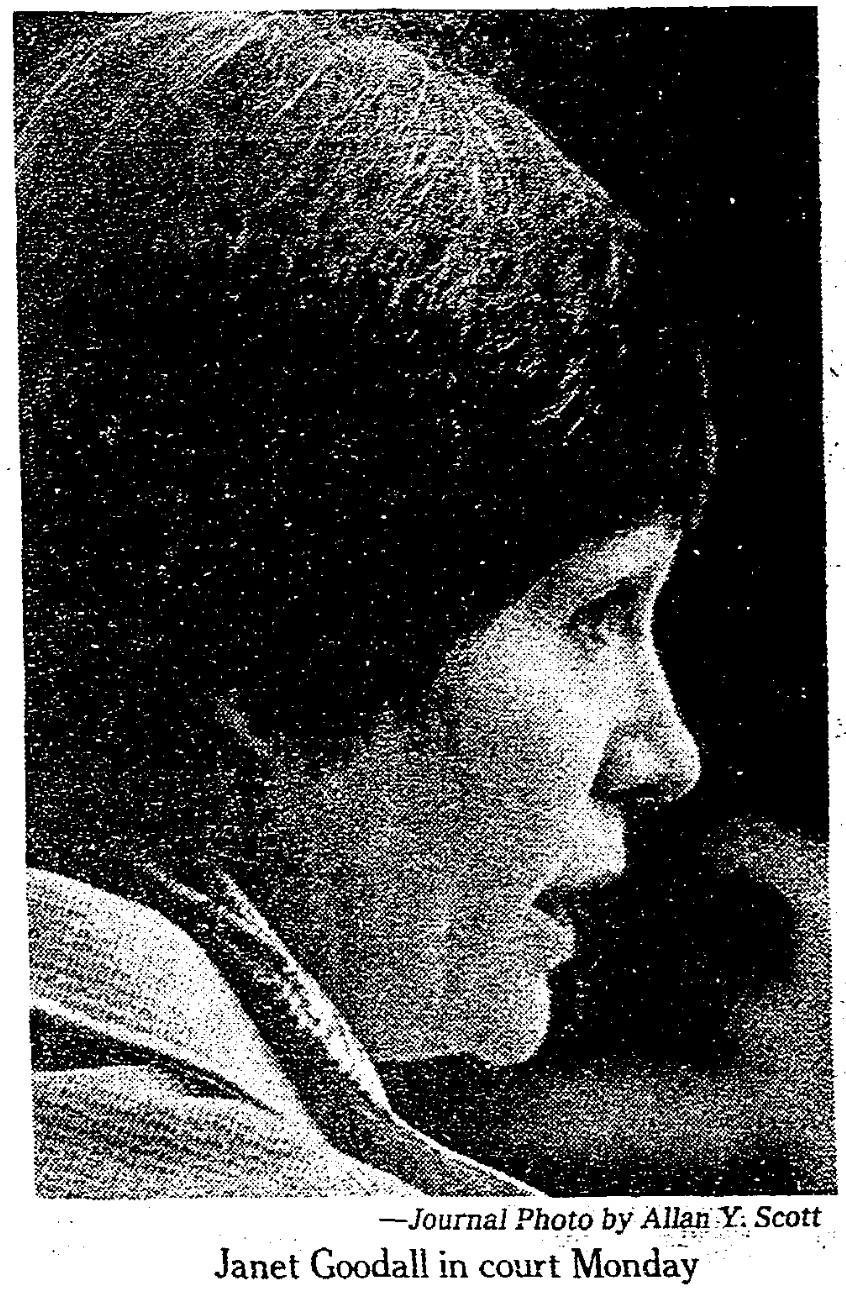
Boss Robert Machotka assigned her the job of evaluating all 250 patients and wanted the report in October 1977. However, when the report was due, her office was “trashed” with papers everywhere. The evaluations were missing. She was given until March 1978 to redo them and when turned in, Machotka said, “They were worthless in meeting the nursing home surveyor’s standards, of course, because they had not been done by a qualified person.. As a matter of fact, they were worthless on their face, because they were compilations of other people’s remarks.” At least $335 was stolen during her time there, and she set up a clothing store at the home – with clothes supplied by a visiting Rev. Tabor. The inventory left over after she left suggested there was more money coming in than clothes going out. Machotka described Tabor to the press: “He was a little evasive, a little officious – he would be talking to me while doing something else – nondescript, graying, just a guy trying to make a buck.”
Of Goodall, Machotka said, “There was nothing stupid about her. Her use of the language was good, her writing capability was good, her interpersonal relationships on the whole were good. She was well liked.” These skills and traits kept her on the job, even as people began to doubt her credentials and identity.
On March 15, 1978, a fire broke out at Goodall’s home in West Salem. She had spent significant money remodeling it. Goodall called Detective Roman Blazer in Milwaukee around 6:45pm and said she felt threatened. Blazer and another detective picked her up the next day and was taken into protective custody in Milwaukee. The sheriff’s department paid for her food and motel bills. Goodall claimed she and Tabor had previously stole money from the Benjamin Health Care Center (2115 East Woodstock Place) while Tabor visited patients there.
Mid-June 1978, Tabor left his church in Escanaba. The church history today says he “unexpectedly resigned.” Contemporary news sources quote Rev. Oscar Naumann, president of WELS, saying he was forced to resign because of allegations of “sexual misconduct” with a local woman.
August 31, 1978: Goodall was arrested and a press conference was called by deputy district attorney Lee Wells. According to Wells, Goodall told police that the earlier story of finding Janice Tabor dead was untrue. Instead, Goodall and Rev. Tabor were in bed that morning and Janice came home earlier than expected. A fight started and Janet chased Janice with a .45, shooting her once at the basement stairs. Tabor allegedly said, “Shoot her, shoot her, don’t let her get away.” Tabor, completely naked, then took the gun and shot his wife twice more. Goodall said she buried the gun in a county park.
On September 1, 1978, Goodall was formally charged with party to first degree murder. In addition to the earlier statement from Wells, the complaint included the detail that Mrs. Tabor had previously confronted Goodall and accused her of carrying Tabor’s illegitimate child. She was, in fact, pregnant and gave birth to a son around March 1977. Wells said Tabor was not going to be arrested and no warrant was out for him. The only evidence against Tabor came from Goodall, who was not considered a reliable witness. Goodall was held on $20,000 bail.
The complaint outlined a series of events where Goodall would make statements and then contradict them. She denied and then admitted starting her own house on fire. She claimed a man was beating her and her 10-year old daughter at a Wauwatosa motel and then later said there was no man and she was doing the beatings herself. She went so far as to dress up as a man when beating her daughter. The daughter was in the hospital for bruises and Goodall was in the hospital a full week from attacking herself with a broken bottle.
On September 19, 1978, James Shellow, acting as Goodall’s attorney, urged Judge Leah Lampone to extradite William Tabor from LaMarque, Texas, where he was believed to operate a tire store. Shellow also complained that his client was promised immunity by the district attorney so long as it could not be shown she fired the fatal bullet.
A hearing was held on October 3 to see if Tabor should be extradited. Attorney Carl Walsh of Chicago appeared on his behalf and said if his client was brought in, he would refuse to testify. Judge Lampone declined to force extradition, saying it would be too expensive for the county and would likely see no results.
A preliminary hearing was held before Judge Frederick Kessler on October 17. Goodall was now represented by Alan Eisenberg. Police argued that Goodall purchased the murder weapon. Eisenberg was able to get medical examiner Elaine Samuels to say Janice had a 45-55% chance of survival if she had only been shot in the back. If it was true that Tabor fired the next two shots, this would suggest that Goodall was not the one who killed her. The charge was maintained and a trial was set for March 19. Goodall pleaded not guilty.
December 1978, while Goodall was in jail, the court had to find placement for her 11-year-old daughter. A psychologist said she was “very distressed and traumatized” and the Lutheran church “reminds her of what happened.” The daughter did not want to see her mother at jail or at trial and said she wanted to be raised Catholic. Goodall questioned whether the court could overrule a mother on what religion to raise a child. This daughter and three others were in the temporary care of a Catholic foster family. Attorney Alan Eisenberg also questioned whether an 11-year-old had the ability to understand the different beliefs of different religions and choose.
January 12, 1979: Eisenberg again asked that Tabor be extradited, and Judge Ted E. Wedemeyer agreed, saying that Tabor was a material witness to the crime (assuming it was true he was there). Wedemeyer moved to extradite Tabor no later than March 1. Prosecutor Lee Wells expected Tabor to fight the extradition.
The extradition never happened, in part because Goodall took a plea bargain on March 15, pleading guilty to being party to murder in exchange for the first-degree murder charge being dropped. She now faced a maximum of 25 years. DA Wells made a statement: “There is evidence that she was one of a series of vulnerable women who were attracted to Tabor and that he sexually exploited them shamefully and in an unprincipled manner.” Wells said that Goodall had no credibility, so he did not know if Tabor was at the murder, but conceded that if he was, Tabor “played the dominant role.”
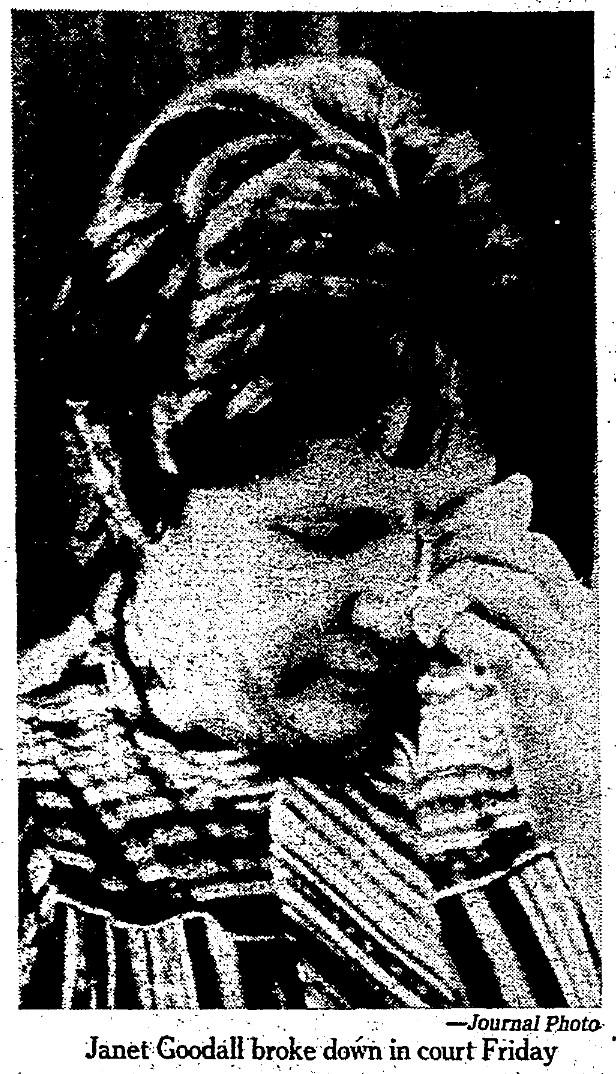
After pleading guilty, Goodall took the witness stand on March 16 for 90 minutes. In her words, “From the beginning, from the time I was born, as far as my contact with men, I guess it all started back then from the day I was born. My father ended up leaving me and my mother in the hospital (in Los Angeles) and my grandmother had to come from Michigan to pay the hospital bill and get us out. And all through my life my family’s never let me forget that fact, that I was just left in the hospital by my father.” When she was 16, she had an affair with a doctor she was babysitting for. The doctor helped her get in to Western Michigan University, but she flunked out. She next married her first husband, but they divorced because he repeatedly attempted suicide to get away from her.
She explained that she first went to Tabor because she wanted counseling on her second marriage, which she felt was breaking up. Tabor soon steered her towards being intimate with him. On the morning of the murder, Mrs. Tabor came home and caught the two in bed. “Jan had a rifle and she was calling me names, which I well deserved at the time,” Goodall said. Tabor had a .45 because (he claimed) it was to be a gift for his son. Turning to his wife, Tabor said, “Your gun isn’t loaded but mine is.” Jan said she would expose the affair and ruin her husband’s career, causing him to chase her downstairs. Tabor yelled at Goodall to fire the first shot, and then took the gun back and finished the job. After the shooting, “I got sick and threw up in the bathroom,” Goodall testified. “He slapped me and told me to pull myself together.”
Goodall explained that she was told to always call him “Pastor Tabor,” even in bed, because people would suspect they had a relationship if she was informal. Goodall claimed to have given Tabor $100,000 over the course of their relationship, and she witnessed other women give him money, too. A woman in her 80s gave him $3,000 and told him to spend it however he liked. Goodall said, “He tells you to do something, and you know that it’s wrong and what he is saying is not right, but he has a power over the mind. It’s unreal. There wasn’t one person he didn’t think he could control. He said everybody has a weakness, and there is something in everyone that you can buy and not necessarily with money.”
Allegedly, on one occasion the police and district attorney told her about another woman who was pregnant from Tabor. Goodall met him at a motel after and asked him about it. “He asked me if I was going to believe him or if I was going to believe the lying Milwaukee Police Department. Pastor convinced me that I was all wrong.” Her defense attorney, Alan Eisenberg, called Tabor “the closest thing to a James Jones or Charles Manson. He cultivated his cult in a different way, but was a cult leader nonetheless. He was a mind exploiter, he was a sex exploiter, and he got several women pregnant… Devil Tabor is the real killer in this case.”
On May 14, 1979, Goodall was sentenced to 10 years in prison for the murder of Mrs. Tabor. She told the court, “The day I took the stand and told the truth I was freed from the mind control of Pastor Tabor.” With regard to Tabor, district attorney Wells said, “We will be alert to newly discovered evidence, credible evidence, believable evidence… We have an obligation not to pursue innocent people and to pursue the guilty only with reliable evidence.” Rev. Tabor was never charged, and apparently never returned to Wisconsin.
In November 1979, Goodall went on trial in LaCrosse for the arson of her home. Her defense attorney, Peter Berg, argued that Detective Roman Blazer used “sex, liquor and coercion” to get Goodall to admit she started the fire of her residence. Blazer said officers, including himself, often treated Goodall to meals while she was in their custody, but denied any sexual contact. Blazer said Goodall admitted starting the fire in two closets of her home.
On November 8, 1979, Goodall was found guilty of arson by a jury of seven men and five women.
A Shocking Postscript
At the time of Janet Goodall’s trial, district attorney Lee Wells told the public, “We are aware of no admission by Pastor Tabor to anyone to the effect that he killed his wife or participated in her slaying.” Whether or not Wells was aware of any admission is not known, but the truth is that the police knew Tabor was the killer as early as November 1976 – one month after the crime. But they found themselves in an interesting predicament.
Rev. Kurt L. Mahnke had ridden with William Tabor from Milwaukee to Indiana for Mrs. Tabor’s funeral. It was on this trip, mere days after the murder, that Tabor confessed to the killing. The details are substantially the same as what Goodall said at her trial. Tabor also told Mahnke that he had taken a polygraph test for the police and failed.
Mahnke, as a pastor, swore an oath never to share a confession. However, it ate him alive and caused him “turmoil” and his wife saw how it was affecting him negatively. He broke down and told Eugene Schroeder, a deputy sheriff, and Schroeder passed on the information to the Milwaukee Police Department. Mahnke feared the information would “destroy” not only Tabor but the lives of his children, and this concern for the children had him clinging to the oath.
Schroeder made multiple attempts to get Mahnke to tell the Milwaukee police directly, but did not succeed. And the Milwaukee police could not go on third-party hearsay. If Mahnke would not testify or at least sign an affidavit, his knowledge was useless. And further still, they could not compel him to testify because of his oath.
How Mahnke went on, knowing that a pastor had murdered and was still representing the church, is a mystery. Did he regret the secret? Did he have second thoughts when Tabor again abused his position in Escanaba? We don’t know. Should an oath keep a clergyman (or attorney, or doctor) from testifying when it’s something as serious as homicide? I don’t know the answer to this question. There are good reasons to have people we can confide in without fear of repercussions… but to what limit?
Janet Goodall later married a third time, to Kenneth Edwin Garthee of Dodge County, Wisconsin. She passed away on December 17, 2008 at age 64. William Tabor never faced justice and passed on March 24, 2015 in Dallas, Texas at age 82.