In the 1960s, the Wayside Inn was owned and operated by Robert “Barney” Fredericks and was known as a hangout for hippies.
On August 31, 1967, Joseph Balistrieri (Frank’s son) purchased the Wayside Inn (720-722 North Water Street) from Werdehoff Realty for $80,000. Included in the deal was an attached tobacco and news store. Balistrieri paid $24,000 down and took out a $56,000 mortgage with Standard Savings and Loan. The FBI speculated that the $24,000 had not come from Joseph’s law practice but from his father. Robert Fredericks moved his business to 607 North Broadway, keeping the name Wayside Inn. This purchase caused the FBI to open a file on Joe (initially a “dead file” where information was stored, not actively investigated). They feared he was “acquiring some of his father’s traits in financial matters.”
October 13, 1967: An informant said a “rumor” was going around that Frank Balistrieri bought a tavern on North Water Street for $100,000, with $20,000 down in cash. The building was put in his son’s name, and was to be an English style pub.
The Milwaukee Sentinel reported on February 21, 1968 that the liquor license from the Le Bistro was being transferred to the Wayside Inn building. The license was in the name of Angelo DiGiorgio, who had been the manager of Le Bistro (“Milwaukee’s newest discotheque”) when it opened in 1964. That building had since been razed, but DiGiorgio held on to the license.
On May 14, 1968, an informant said that Balistrieri was using Walter Brocca as a contractor for 722 Water Street, with improvements expected to run $35,000 to $50,000.
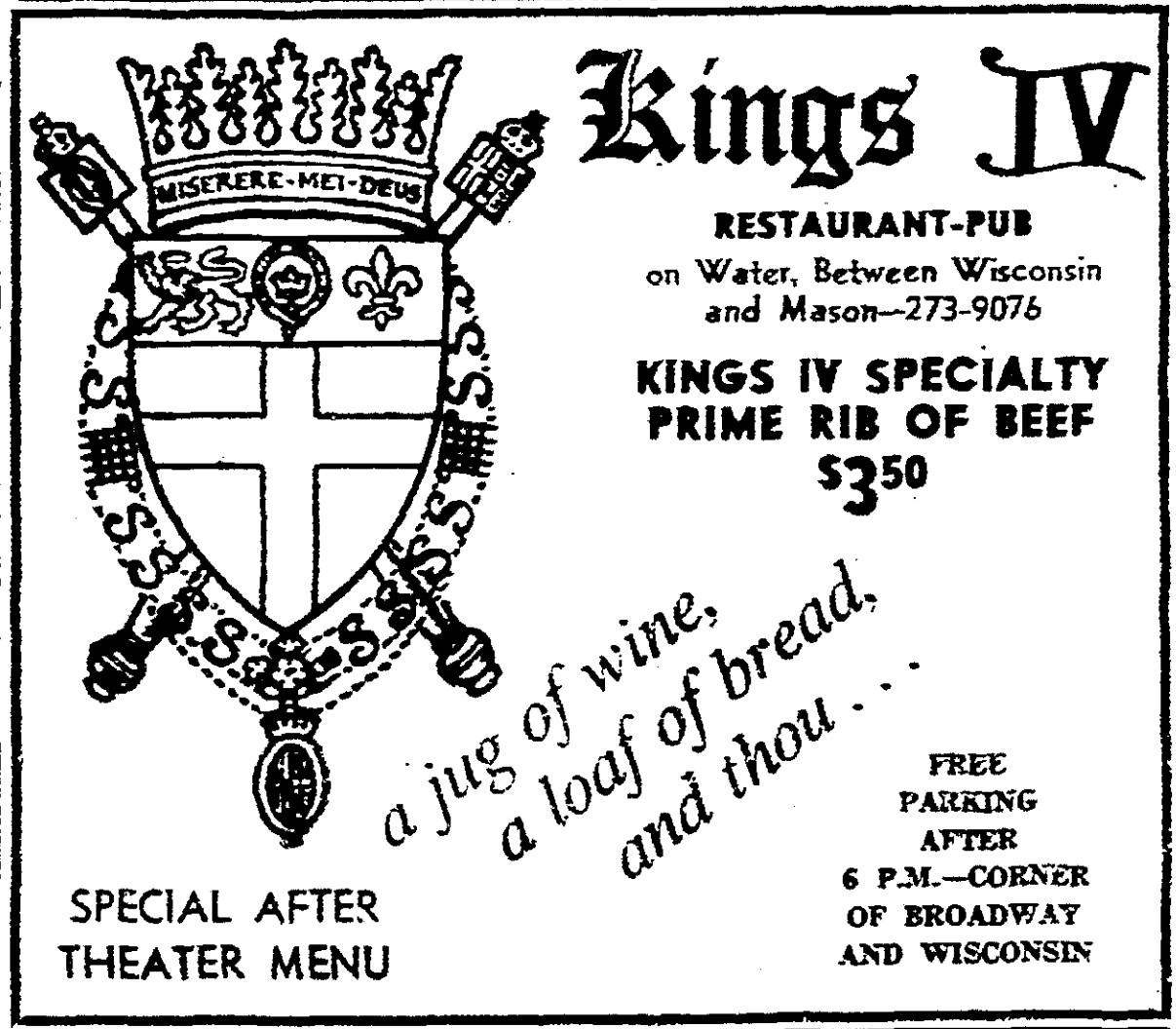
March 7, 1969: The Kings IV (722 North Water) opened. A good crowd was at the opening, including alderman Allen Calhoun and state senator Martin J. Schreiber (a future Wisconsin governor).
Two special agents went to the Kings IV on June 24, 1969, from 9:00pm until 10:00pm and saw a few people, including a liquor salesman (name redacted) and gambler William Cole, who was very intoxicated. Cole and the other man were complaining they got stood up by two women. The agents spoke to the bartender and asked if the upstairs was open, but they were told it would not be for a couple of weeks. Frank Balistrieri’s Cadillac El Dorado was parked outside in a “no parking any time” zone, but he was not seen.
The FBI called the Kings IV on November 25, 1969 asking to speak to bartender Nicolo Safina. When Safina was reached, he said he had no interest in setting up an interview with the FBI and had nothing to offer them. He abruptly terminated the conversation and hung up.
Frank Balistrieri threw a Christmas party on December 21, 1969 at the Kings IV Tavern (722 North Water Street). Approximately 150-200 guests were there, including Walter Brocca, Harry DeAngelo, Albert Albana, Frank Buccieri, Dominic Frinzi, Frank Stelloh, Steve DiSalvo, Benny DiSalvo, Jerry DiMaggio, John Rizzo, William Covelli, Dominic Gullo, Joseph Enea, Allen Calhoun, Sally Papia, Angelo DiGiorgio, Frank Daddaboo, and the majority of the Milwaukee LCN. Notably, the “old guard” (guys like Nick Fucarino and Sam Ferrara) were not at the party.
Peter Balistrieri was denied a liquor license for Kings IV on December 22, 1969 due to pending charges against him, and because he already owned licenses for The Scene and Gallaghers (the city had a two license limit). Balistrieri was attempting to take over the tavern from Angelo DiGiorgio, who would have to surrender his license if convicted of pending gambling charges.
February 12, 1970: Count Basie played in Arthur’s Room at the Kings IV for one night only. Woody Herman played there in March.
A party was held at the Kings IV on the evening of March 15, 1970. Police wrote down the license plates and found the following attendees: Frank Balistrieri, Peter Balistrieri, someone from Lando Enterprises (4702 West Vliet), Carl J. Dentice, someone from Glenbrook Corporation (6925 North Port Washington Road), Vincent Maniaci, Harry D’Angelo, someone from Schaub Buick (237 South Street in Waukesha), someone from Rank and Son Buick (4200 North Green Bay Avenue) Frank C. LaVora (3120 South 51st Street), Salvatore Dentice (1611 North Jackson), Sam J. Cefalu, Salvatore A. Librizzi, Joseph Caminiti and Albert Albana.
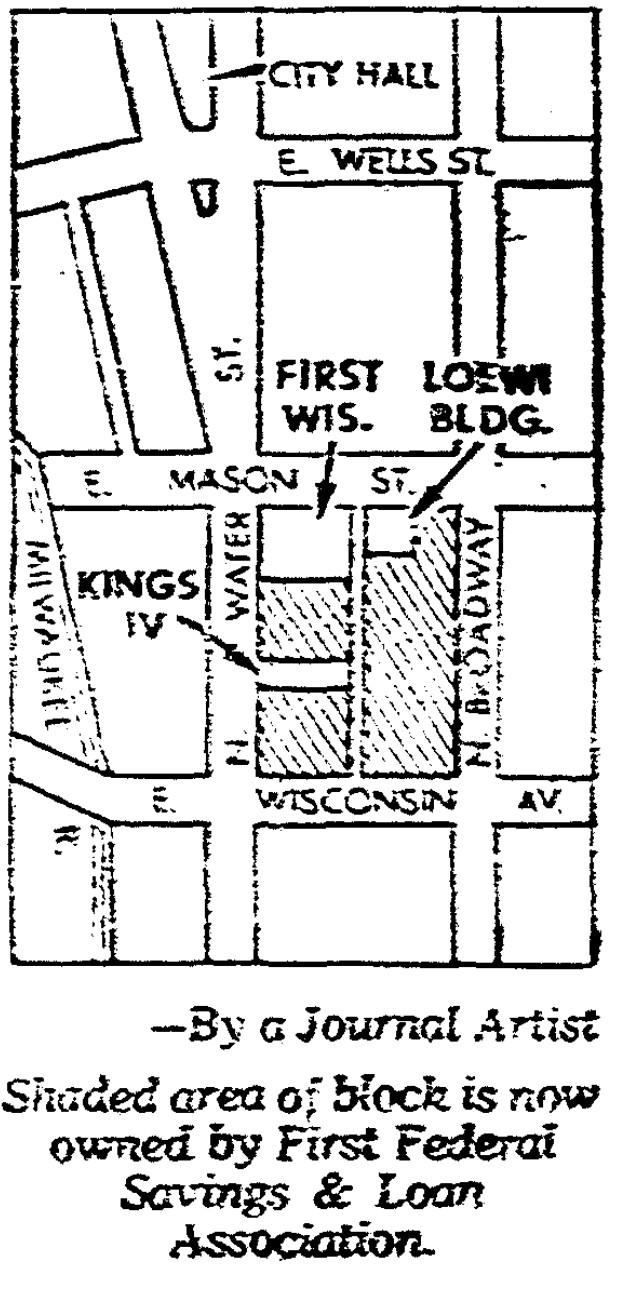
June 30, 1970: First Federal Savings and Loan purchased the 14-story Bankers Building (208 East Wisconsin Avenue) from Towne Realty. They did not publicly say the price, but the building was assessed at $1,752,000. With this purchase, First Federal now owned almost all of the block created by Wisconsin, Water, Mason and Broadway. The only properties remaining were the Loewi Building (225 East Mason), the First Wisconsin National Bank parking ramp (734 North Water) and the Kings IV. “For the present, we plan to leave the Bankers Building intact,” president Robert Brown said. “First Federal does plan to utilize first and second floor space in the building for its own purposes.”
Frank Balistrieri threw a party at the Kings IV on July 26, 1970. He charged $15 a plate and roughly 100 people attended, including Vincent Maniaci and Steve DiSalvo.
Around August 10, 1970, Joseph Balistrieri was offered $500,000 for the Kings IV night club by First Federal Savings and Loan. Allegedly Balistrieri was not sure about the offer because of tax liabilities attached to the building.
Agents from the state attorney general’s office tried to go into a locked basement area of the Kings IV on October 6, 1970, but were blocked by licensee Peter Gaudesi, saying they needed a search warrant. The same evening, the agents returned and read a notice to Sue Bartfield (the tavern’s representative in Gaudesi’s absence) informing her that the tavern’s license was revoked on suspicion of violating liquor laws. Bartfield and the bartender on duty asked the patrons to leave. AG Robert Warren released a statement saying any denial of access to an inspector is an automatic license revocation. (In 1983, a man named John Forbes claimed attorney general Robert Warren had him do several illegal things to “get” Frank Balistrieri, including planting a bottle of stolen liquor in the basement of Kings IV.)
October 7, 1970: Peter Gaudesi filed a restraining order against Robert Warren and state tax secretary James Morgan. He asked the license revocation be placed on hold until the hearing, and continued to run the Kings IV as if nothing happened. Judge John Decker set the hearing for October 13. Gaudesi argued that the statute Warren used confiscates property without due process of law. Gaudesi also denied that agents could enter locked areas of the tavern without a search warrant.
November 27, 1970: First Federal announced they had reached a deal with Joseph Balistrieri and purchased the Kings IV. They now had virtually the entire block bounded by Wisconsin, Water, Mason and Broadway. For the short term, the bar/restaurant was not required to vacate and continued business as usual. (The purchase price was not made public at first, but it was later reported as $595,000.)
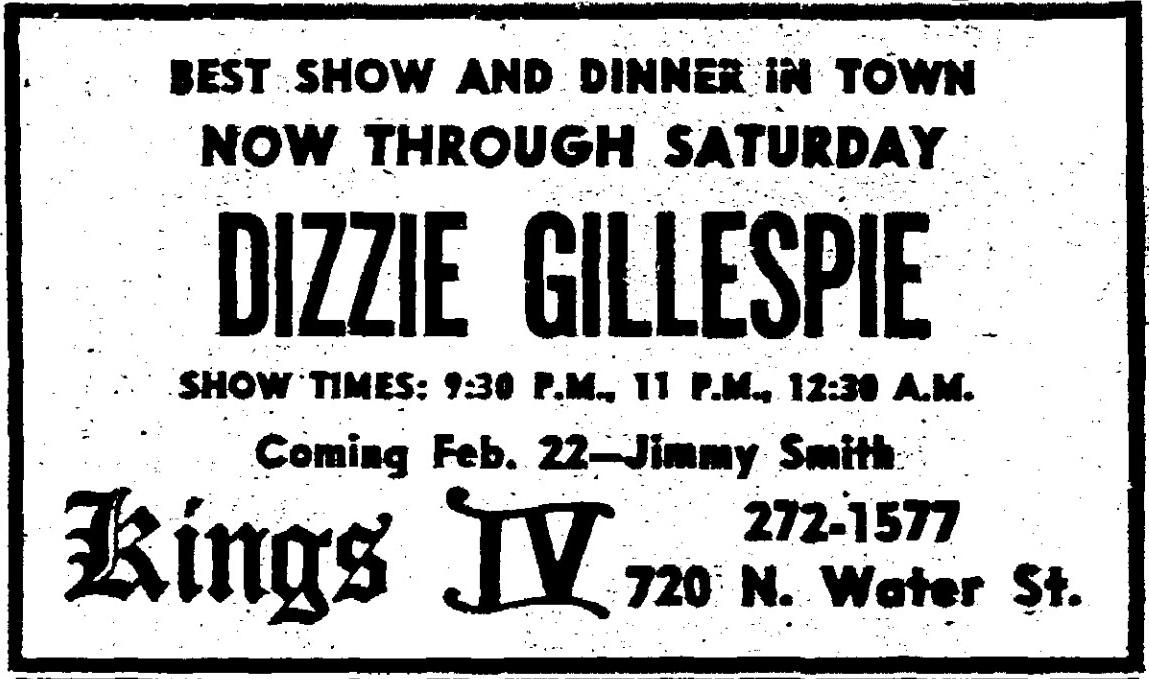
February 1971, musical guests included Dizzy Gillespie and Jimmy Smith.
May 29, 1971: Basic Fixtures sued Joseph Balistrieri for $7,341 claiming he had not paid them for cabinets, booths, tables and other items installed in 1968-1969. They said Frank Balistrieri had acted as an “agent” for his son in the transaction. (On July 31, 1972, Oscar Plotkin told state agents Basic Fixtures got “screwed out of a lot of money on the Kings IV” when they provided the furnishings.)
July 16, 1971: State agents running surveillance saw Peter Gaudesi, who they knew was wanted by federal authorities for a subpoena. They tipped off the feds, who served the subpoena. At the time of being served, Gaudesi informed them, “I own the Kings IV tavern.”
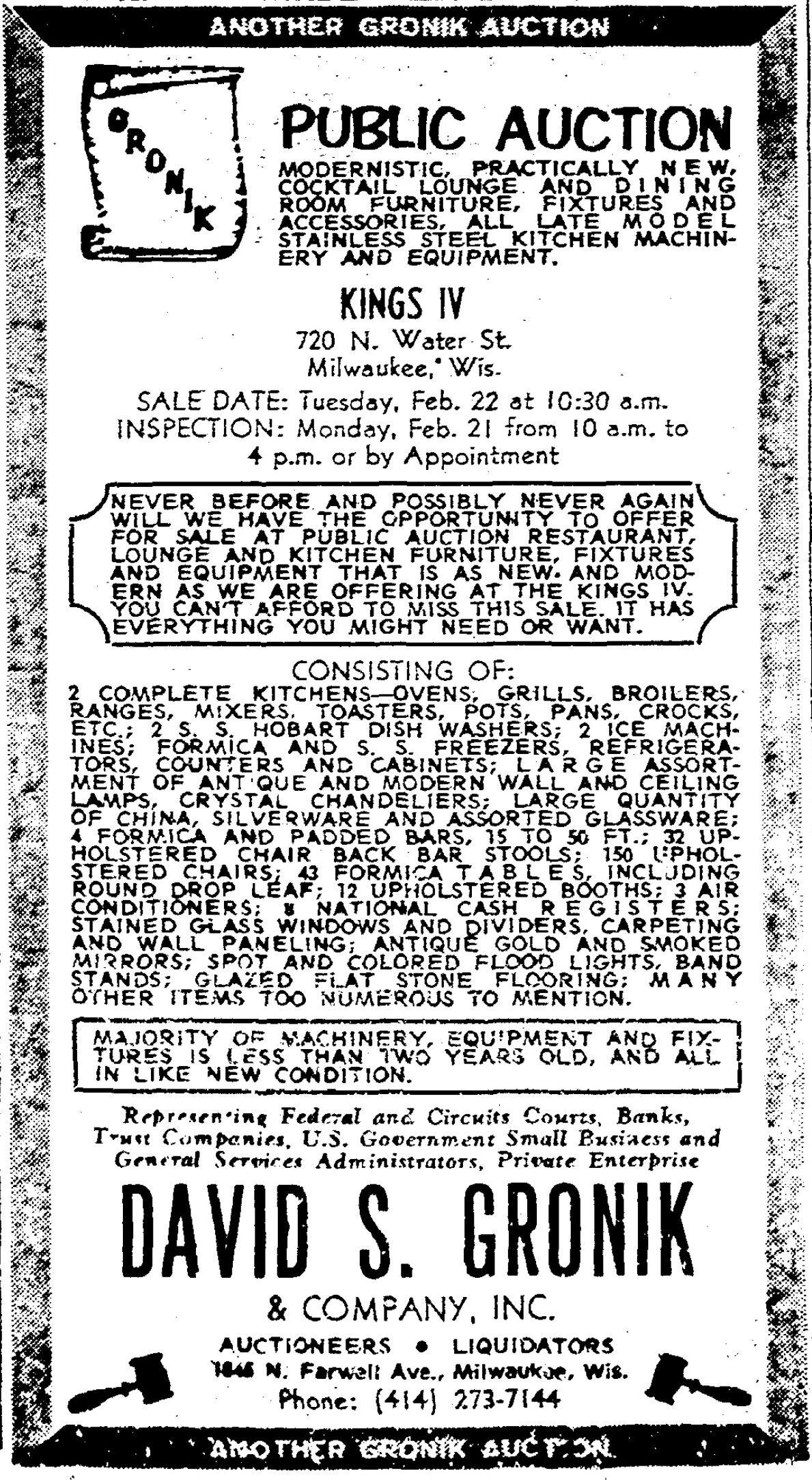
February 22, 1972: Everything inside the Kings IV was auctioned onsite by auctioneer David Gronik.
September 14, 1972: Sue Bartfield (2035 North Lake Drive) appeared before the new federal grand jury looking into the Kings IV. She was granted immunity to prevent her from invoking the Fifth.
December 17, 1972: Bentley-Jost Electric sued Joseph Balistrieri for $10,037 alleging he still owed them for remodeling the Kings IV years ago.
September 20, 1976: A Milwaukee Journal article said the IRS and Joseph Balistrieri were ready to go to trial. The IRS alleged Joseph underpaid his income taxes in 1970 and 1971 by $147,000. The bulk of this — $142,000 – was capital gains tax from selling the Kings IV building at 720 North Water Street to the bank on November 26, 1970. Balistrieri said this tax should be waived because of a regulation that said property sold under threat of imminent condemnation is not taxed if the money is reinvested in another property. He further argued the tax calculated was higher than it should be – his capital gains were lower than they claimed. Other lesser disputes were whether Balistrieri deducted too much based on real estate taxes paid, and whether or not he could claim his brother John as a dependent like he did.
April 25, 1977: Balistrieri’s tax case before Judge William H. Quely was scheduled for this day. (Seems like it was delayed due to motions and whatnot.)
May 19, 1977: Balistrieri petitioned for the release of grand jury testimony into his taxes that was recorded in 1975. Specifically, he wanted the testimony of accountant Eugene Koenen (who prepared Balistrieri’s taxes) and attorney Gregory Gramling, who helped Balistrieri negotiate with First Federal. Both men supported the release of their testimony.
March 28, 1978: Joseph Balistrieri testified in US Tax Court. He said he purchased the building at 720 North Water in 1967 for $80,000 with help from a loan from his grandfather. He said he intended to rename the building the Balistrieri Building in his grandfather’s honor and move his law office there. Balistrieri said the name was important to showcase in the financial district so “when the silk-stocking lawyers from Foley and Lardner came out of the door, it would hit them right in the face.” That law firm was at 743 North Water. Joe said his grandfather came from Sicily and “was a bricklayer by day and a mandolin and guitar player in saloons by night… I come from a family of saloonkeepers.” He never moved the law office there because First Federal Savings and Loan wanted the property razed so they could expand their building and asked the city council to condemn it as part of urban renewal. Feeling he had no choice, Balistrieri sold the property to the bank in 1970 for $595,000. He used the profit to purchase the Shorecrest Hotel at 1962 North Prospect for $1,000,000. His argument was that capital gains were not taxed if reinvested. Joe said he was shocked a private business could use the power of the city to condemn a building and compared it to the Italian church being removed in 1967 to make way for the freeway when (in his opinion) there were better neighborhoods that could have been torn down. Acting as witnesses for Balistrieri were attorney Dominic Frinzi, attorney Gregory Gramling, alderman Mark Ryan, brother John Balistrieri and bank president Robert Brown. Tax court judge Irene Scott was expected to take “several months” studying the case.
Balistrieri reported his 1971 income as $3,594, 1973 income as $26,260, and 1975 income as $48,802. This is impressive growth and doesn’t take into account the major real estate investments.
April 6, 1979: Judge Scott sided with Joseph Balistrieri that he had followed the law correctly – his building was under threat of condemnation, and the proceeds of sale were used to buy another building, so the $142,000 in taxes were not owed. The court said “there can be a valid threat of condemnation where the party making the threat does not have the power of condemnation, provided that such power is readily attainable.” The threat came from First Federal bank, but testimony supported the claim that the city council would have supported the bank’s request to have the building condemned for urban renewal. Following the decision, attorney James Shellow (representing Balistrieri) said, “Joseph Balistrieri was being absolutely candid in his testimony. His candor clearly impressed the trial judge and I am certain was largely responsible for the favorable opinion.”